AI Healthcare Startup Marketing: How Viz.ai Sold to Doctors, Not Patients
AI healthcare startup marketing works best when it speaks to the clinicians who use the product, not the patients who benefit from it. Viz.ai is the clearest proof. The stroke AI company reached a $1.2 billion valuation by marketing to doctors and hospitals, not patients.
It sells time to treatment, not artificial intelligence, and lets a neurosurgeon founder carry the message. Unlike the common advice to build broad awareness first, Viz.ai went narrow. Today its platform runs in more than 2,000 hospitals.
What Is Viz.ai?
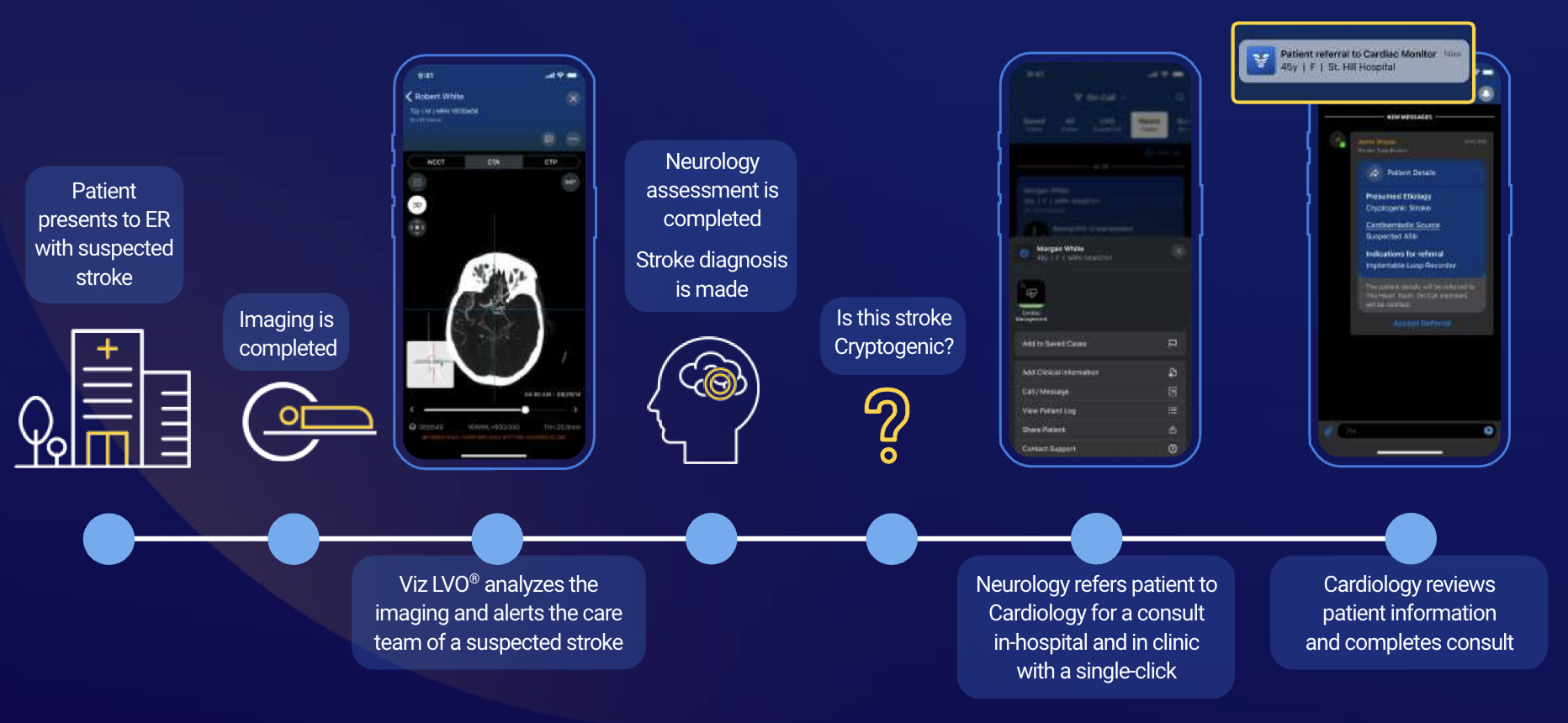
Viz.ai is an AI-powered care coordination company based in San Francisco. Its software analyzes CT scans, flags a suspected large vessel occlusion (LVO) stroke, and alerts the stroke team on their phones within minutes. Specialists can then decide on treatment such as thrombectomy faster.
Speed matters because a stroke patient loses about 2 million brain cells every minute, according to TIME's profile of the founder.
Neurosurgeon Dr. Chris Mansi co-founded Viz.ai in 2016 with machine learning researcher Dr. David Golan at Stanford. In 2018, its stroke software became the first AI computer-aided triage tool to receive FDA De Novo clearance.
In 2020, Viz.ai became the first AI software to receive a New Technology Add-on Payment (NTAP) from the Centers for Medicare and Medicaid Services (CMS). In April 2022, a $100 million round valued the company at $1.2 billion.
Why Did Viz.ai Market to Doctors Instead of Patients?

Viz.ai marketed to doctors because patients do not choose the software that reads their scan. A stroke patient arriving by ambulance never picks a hospital's triage tool. The health system is the buyer and the clinician is the daily user, so every message went to them.
The company focused on four hospital groups:
- Neurologists and neurointerventionalists, who need to know about a treatable stroke fast.
- Emergency physicians, who make the first call.
- Radiologists, whose daily workflow the software plugs into.
- Hospital administrators, who sign the contract and track outcomes and reimbursement.
That last group writes the checks. Forbes reported that a small hospital might pay about $50,000 a year for Viz.ai, while a larger health system could spend more than $1 million.
This is the core of health tech B2B marketing: the end beneficiary is not always the buyer. We saw a similar split in our breakdown of Butterfly Network's medical device marketing.
How Does Viz.ai Sell Time to Treatment Instead of AI?

Viz.ai leads with minutes saved, not machine learning jargon. Its research, case studies, and conference talks center on clinical metrics such as door-to-groin puncture time and door-in-door-out time. Stroke teams already track those numbers and are often judged on them.
One comprehensive stroke center study indexed on PubMed found that median door-to-groin time fell from 109 minutes to 75 minutes after the hospital adopted Viz LVO.
The share of patients treated within 90 minutes rose from 26.5% to 68.1%.
In March 2026, Viz.ai presented data at the International Stroke Conference showing a 44% reduction in door-in-door-out time for LVO patients in regional care settings.
A doctor does not need to understand neural networks to understand a 34-minute gain. The outcome does the selling.
What Are the Three Plays Behind Viz.ai's Marketing?
Three repeatable plays sit under Viz.ai's messaging: a clinician founder who speaks as a peer, clinical evidence published as content, and product explanations built around workflow instead of algorithms. Each one builds trust with skeptical clinical buyers, and smaller startups can copy all three.
Play One: The Neurosurgeon Founder Is the Credibility Engine
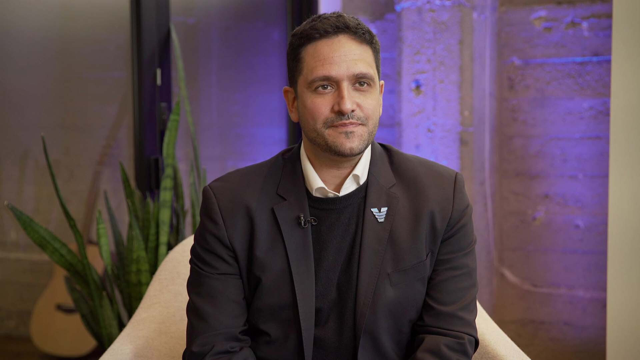
Mansi built Viz.ai from the problem side. During neurosurgery training, he watched time-sensitive patients wait hours for the right specialist, and his bio states fewer than 10% received brain-saving treatment in time.
When a neurosurgeon explains that broken workflow, other physicians listen as peers, not prospects.
He has told that story on the TEDMED stage in 2018, on clinician podcasts like BackTable, and as a TIME100 AI honoree in 2024.
In that Forbes interview, Mansi said the team worked with hospitals "before it was fully baked" to stay focused on real clinical need. A founder's origin story is often a startup's most credible asset, as we explain in our guide on founder-led video.
Play Two: Clinical Evidence Becomes the Content
For Viz.ai, the research library is the marketing library. Hospitals use the platform, physicians publish results, and those results become proof for the next hospital.
Viz.ai also announced a No. 1 ranking in the 2026 Black Book survey of AI clinical decision support, based on feedback from 1,237 healthcare professionals.
Play Three: The Workflow Is the Explanation
Viz.ai's product story fits on a napkin: scan, AI read, phone alert with images, coordinated treatment.
Consistency is part of that story. Mansi told Stanford Biodesign that the first FDA study cut the standard deviation in time to treatment from 127 minutes to 7, so care works the same at 3 a.m. as at noon.
In our work with DeepTech founders, the most common mistake we see is explaining the model instead of the workflow. Short explainer animations fix it, as we cover in our guide to making a startup explainer video.
How Is AI Healthcare Startup Marketing Different From Consumer Marketing?
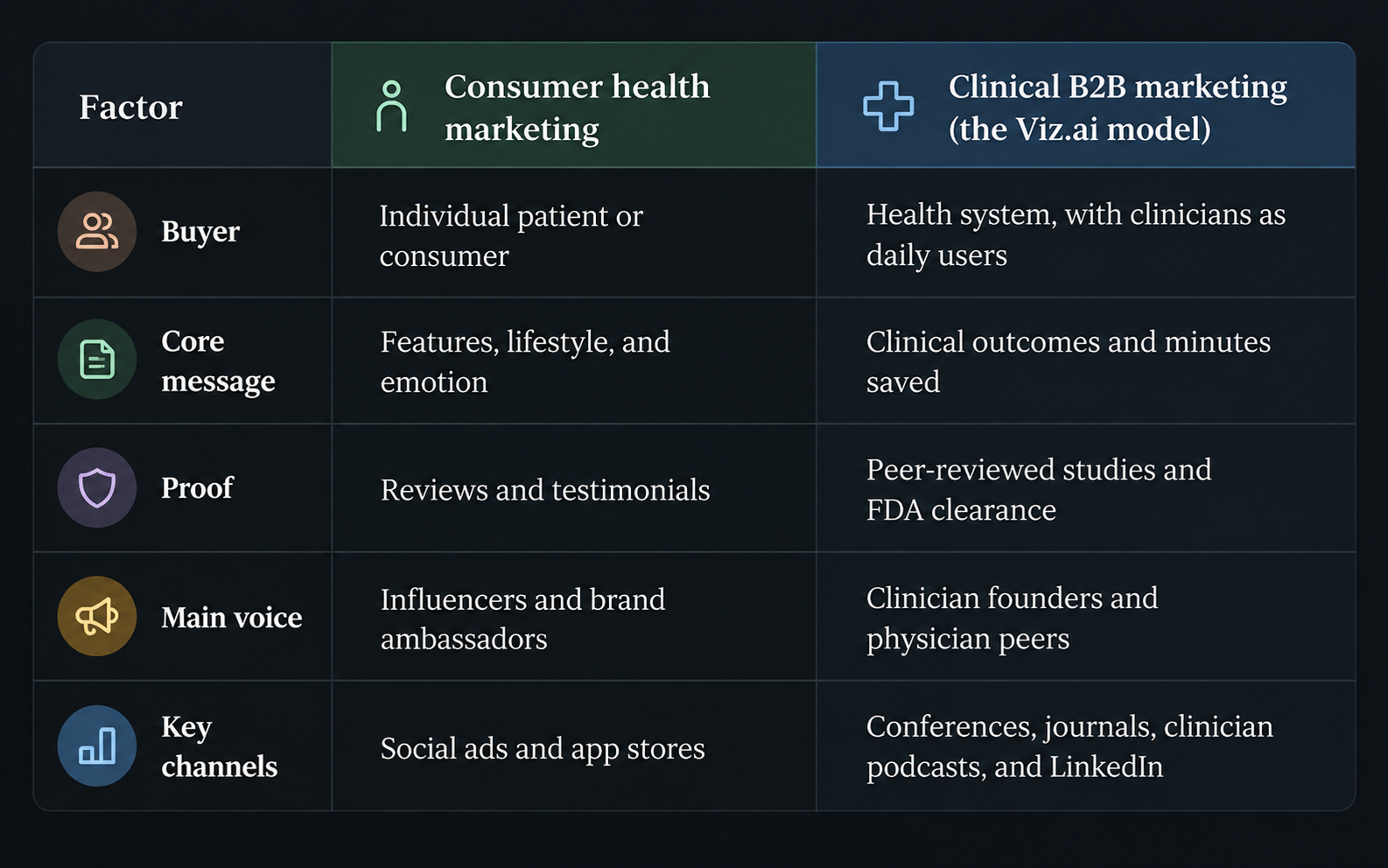
AI healthcare startup marketing aimed at clinicians trades reach for trust. Consumer health brands chase volume with emotional ads and influencers, while clinical B2B brands like Viz.ai win smaller expert audiences with peer-reviewed data, workflow proof, and trusted physician voices.
What Can AI Healthcare Startups Copy From Viz.ai?
AI healthcare startups can copy Viz.ai's playbook without a unicorn budget or a big team. The core moves are mapping the buyer, owning one clinical metric, publishing evidence as content, and putting a clinical founder on camera. Do them in this order.
- Map the buyer before the message. List who uses, who pays, and who approves.
- Own one clinical metric. Find the number your buyers are already measured on.
- Turn every study into content. A pilot result can become a video, a post, and a sales asset.
- Put your clinical founder on camera. Lived experience earns trust that ads cannot buy.
- Animate the workflow. Show what changes for each person on the care team.
- Repurpose every talk. Our webinar repurposing framework turns one session into weeks of clips.
For more format ideas, see our guide to video marketing for health tech startups.
Build a Content Engine Around Your Founder
Viz.ai's neurosurgeon founder was the most trusted voice it had. Your founder is yours.
At Alluvium Media, we help DeepTech and health tech founders build a content engine around their expertise. We script founder-led videos, create explainer animations that simplify clinical workflows, and repurpose every conference talk and podcast into content that reaches the right clinical audience.
No fancy equipment needed. If you want doctors, hospital buyers, and investors to trust your company the way clinicians trust Viz.ai, book a call with our team.

Frequently Asked Questions