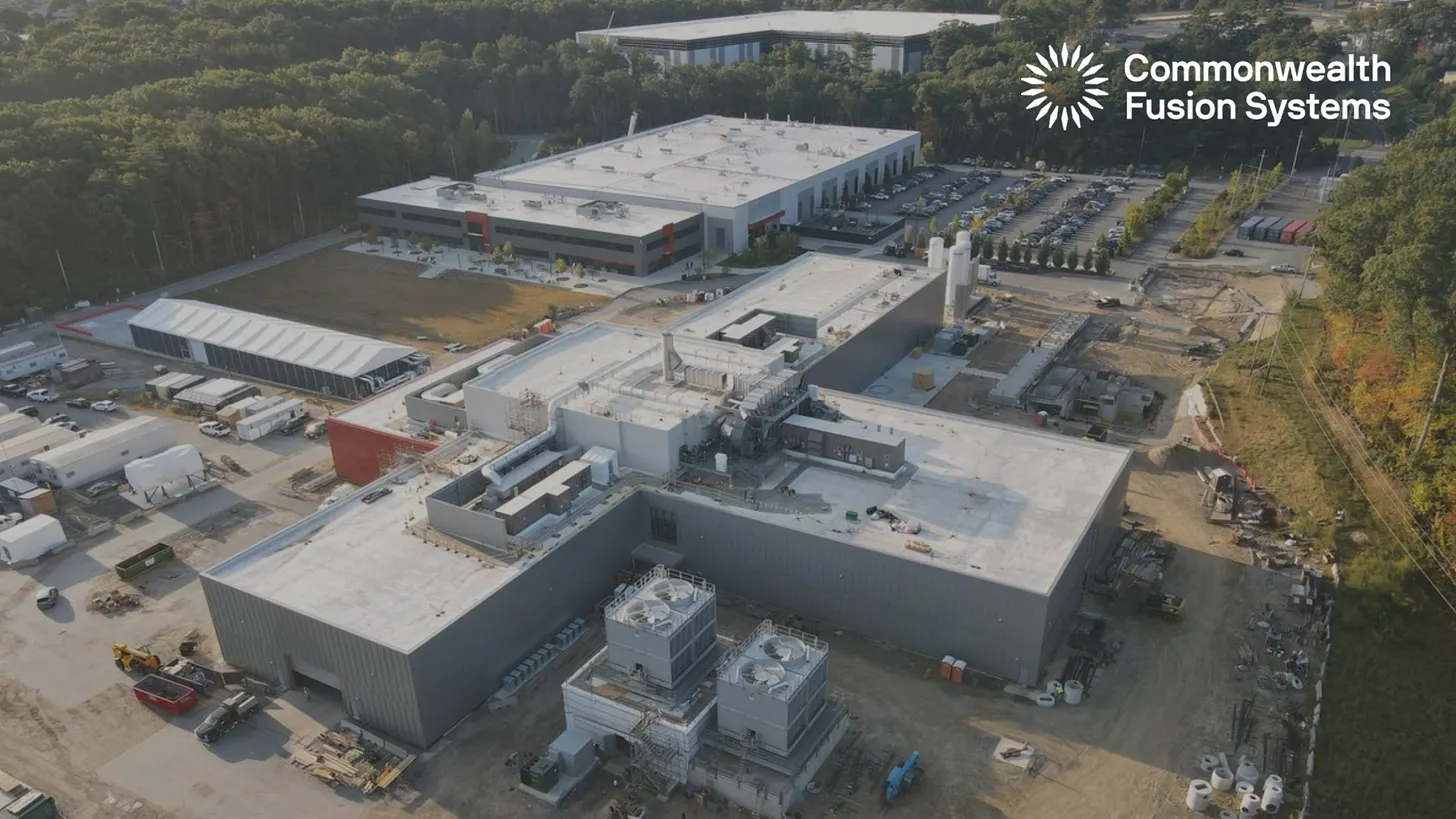
Fusion Energy Startup Marketing: Helion vs Commonwealth Fusion, Two Opposite Playbooks
Fusion energy startup marketing has split into two playbooks, and the two best-funded companies in the category are each running one. Commonwealth Fusion Systems markets like a future utility, with a brand platform, a trademarked tagline, and a CEO positioned as an industry statesman. Helion markets like a startup shipping a product, with signed contracts, construction permits, license approvals, and public deadlines.
Neither approach is wrong. Your deep tech go to market strategy should match what your company can prove, and when.
We already broke the Commonwealth Fusion approach down on its own. This piece puts it side by side with Helion's, because the contrast is the most useful lesson available to any deep tech founder right now.
The Two Companies, Quickly
Helion is a fusion energy company based in Everett, Washington, founded in 2013. Its machine uses a field-reversed configuration that recovers electricity directly from the plasma instead of boiling water to spin a turbine. In June 2026 it raised $465 million at a $15.5 billion valuation, taking total funding past $1.5 billion.
Commonwealth Fusion Systems, or CFS, is a 2018 MIT spinout based in Devens, Massachusetts. It is building the SPARC tokamak using high-temperature superconducting magnets, has raised roughly $3 billion, and is targeting grid power in the early-to-mid 2030s.
Same industry. Same investor pool. Completely different marketing.
Helion's Playbook: The Milestone Drumbeat
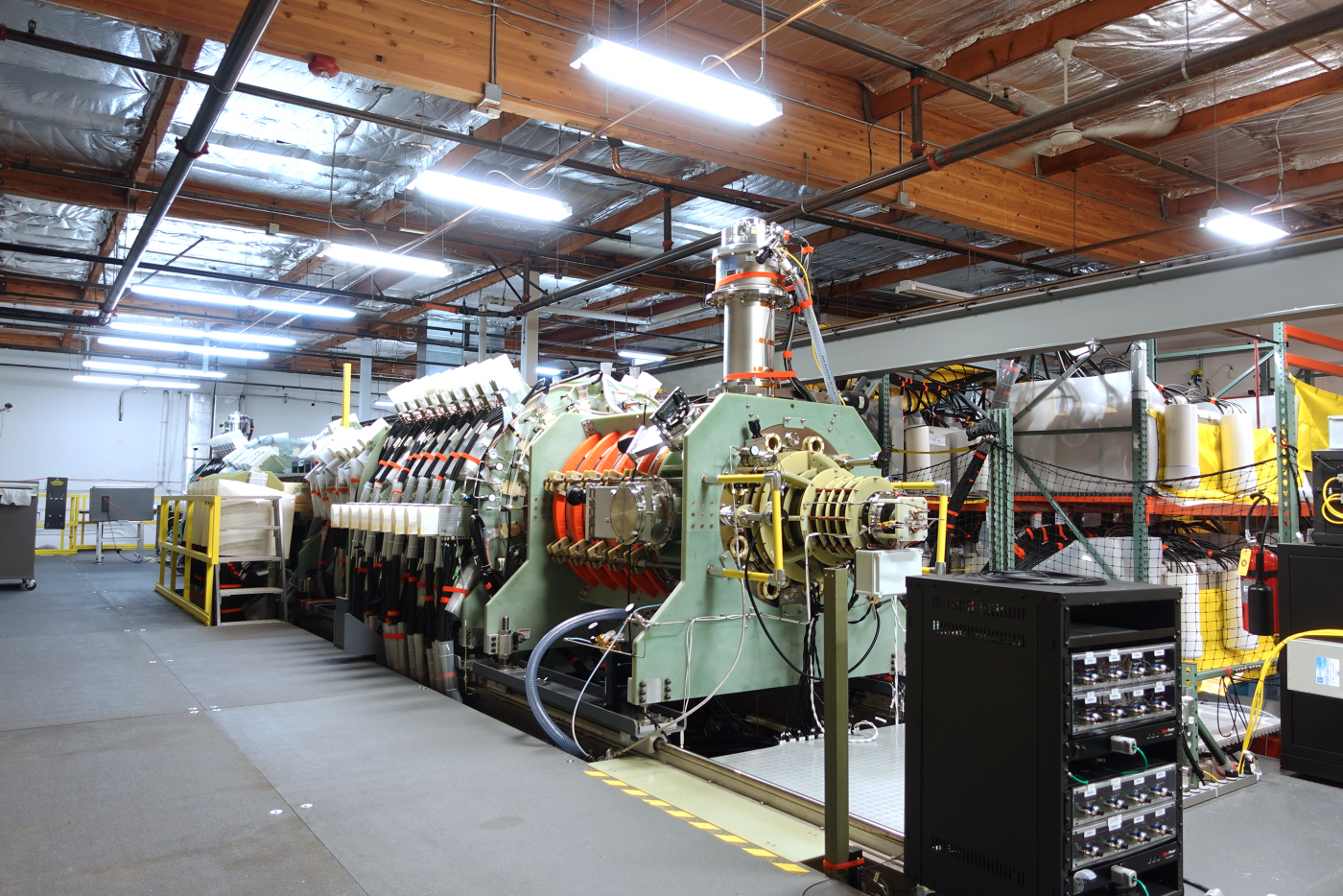
Helion does not run brand campaigns. It runs a countdown, and every announcement is a checkpoint on it.
The clock started in May 2023, when Helion signed the world's first fusion power purchase agreement, agreeing to supply Microsoft with electricity from its first plant. The deal targets 50 megawatts or more, online by 2028, with Constellation acting as power marketer.
That single announcement changed the category. Fusion stopped being a science story and became a business story, because a named customer had signed a contract with penalties attached.
Every Milestone Becomes a Publishing Event
What followed was a steady sequence of provable events, each announced the moment it landed.
Helion broke ground on Orion, its first commercial plant in Malaga, Washington, in July 2025. Polaris, its seventh-generation prototype, became the first privately funded fusion machine to run on deuterium-tritium fuel and pushed plasma temperatures past 150 million degrees Celsius.
Then in June 2026 the company announced it had become the first in the world to hold the regulatory licenses needed to build and operate a fusion power plant, after Washington's Department of Health issued a Radioactive Materials License and a Radioactive Air Emissions License.
Helion even publicises the unglamorous work. It revealed a smaller testbed called Tiny Merge, roughly one-eighth the size of Polaris, built so the team can iterate faster and cheaper.
The CEO Leads With Dates, Not Vision
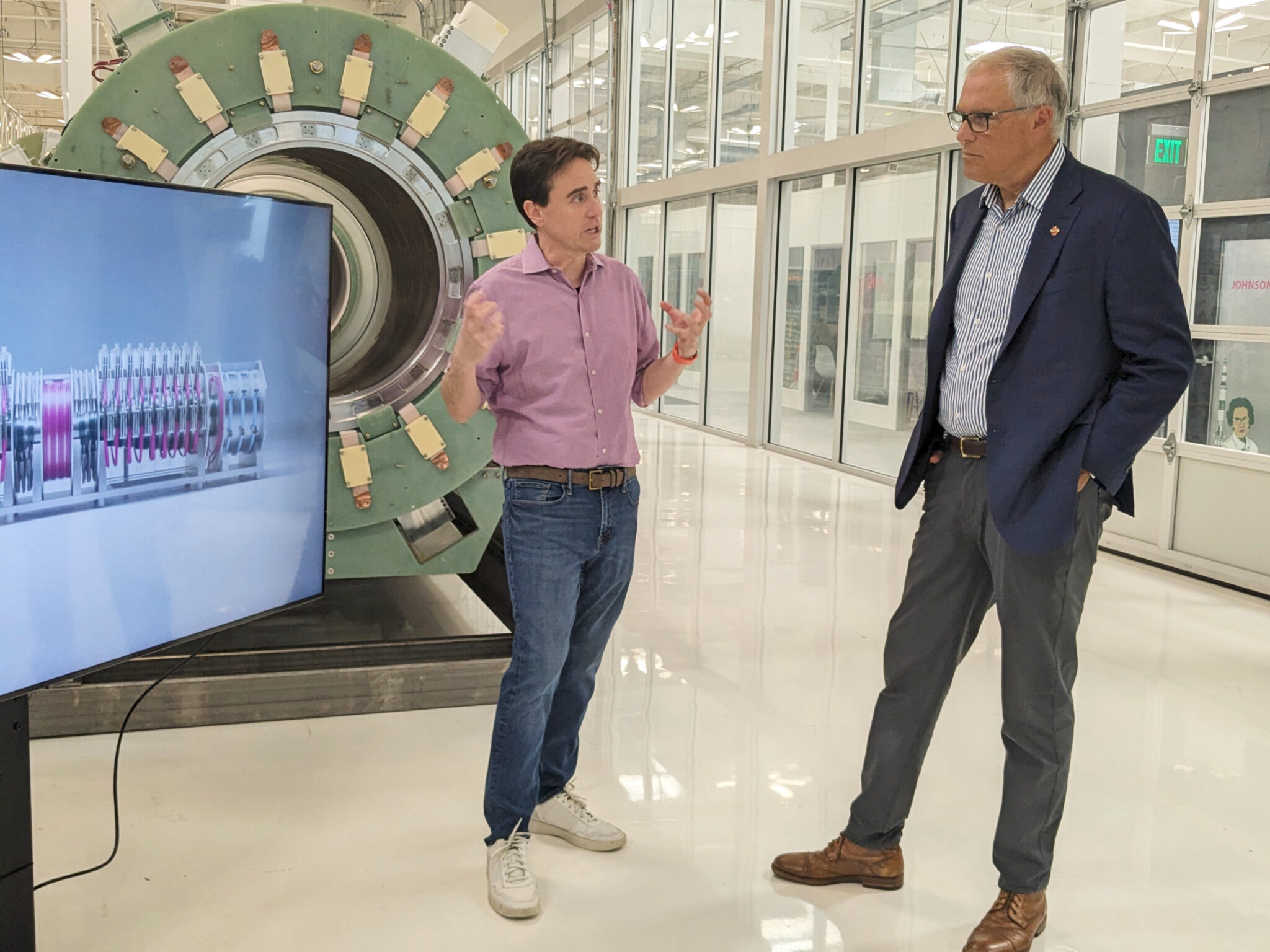
Most deep tech CEOs sell inevitability. David Kirtley sells a schedule.
When the Series G closed, his framing was that Helion is best positioned to generate electricity from fusion for customers this decade, not the next. That sentence is a deadline wearing a quote's clothing.
The tradeoff is real. Public deadlines create urgency, media coverage, and investor confidence, and they also create a very visible way to be judged. Helion accepted that risk on purpose when it signed a commercial contract with financial penalties instead of a research agreement.
The CFS Playbook: Brand-First Credibility
CFS went the other way and hired brand strategists. Working with agency Supermoon, it built a full brand platform aimed at investors, policymakers, talent, and future customers, landing on the tagline Humanity's power move.
The visual system is deliberately documentary. Supermoon's own case study notes that CFS photography shows what is already real, because in an industry full of hype merchants, leadership wanted to avoid any perception of overpromising.
CEO Bob Mumgaard plays the matching role. He speaks less like a founder chasing a launch date and more like the person explaining an entire industry to the people who will regulate and finance it.

That fits the timeline. When your first grid electricity is targeted for the 2030s, you cannot market delivery dates every quarter. You market belief, credibility, and category leadership instead.
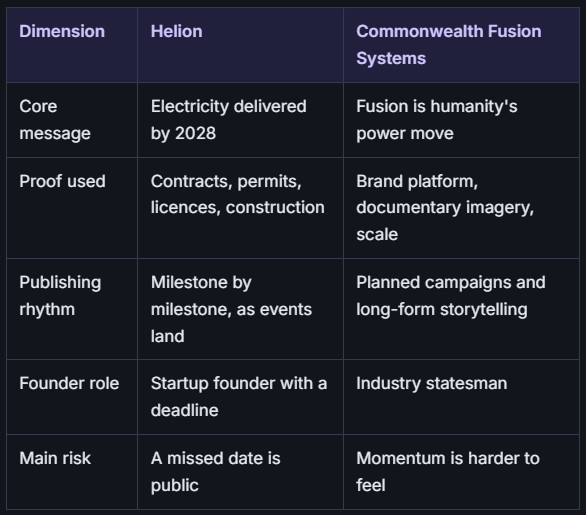
Two Playbooks, Side by Side
Which Playbook Fits Your Deep Tech Company
Four questions decide it, and none of them are about budget.
How close is your first paying customer? A signed commercial contract earns you the right to market deadlines. If revenue is five or more years away, deadlines become a liability and brand becomes the safer asset.
Does your work naturally generate news? Permits, prototypes, pilot sites, and trial results give you a drumbeat for free. If your next two years are quiet lab work, you need created content, not announcements.
Who do you need most this year? Customers respond to proof of delivery. Talent, policymakers, and late-stage investors respond to positioning and mission.
Can your founder carry a public promise? The milestone playbook only works when someone is willing to stand behind the date on camera, repeatedly. If that is not your founder, do not force it. Our guide to founder-led video covers how to build that comfort.
The Thing Both Companies Get Right
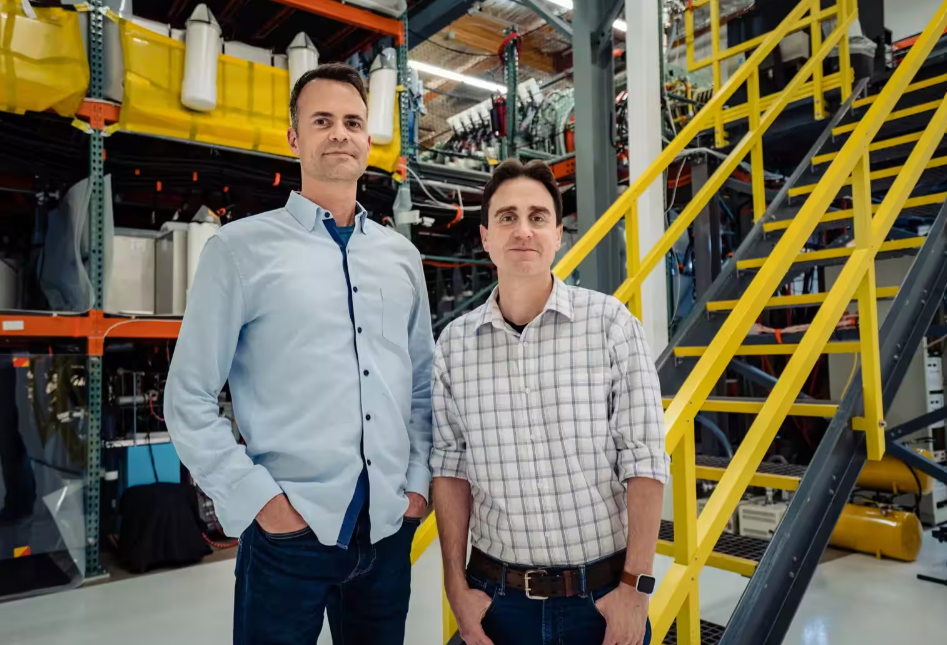
Strip away the difference in style and one habit is identical. Both treat every real-world moment as raw material for content.
CFS films its facilities. Helion photographs its plasma, its construction site, and its machines. Neither company waits for a marketing campaign to justify pointing a camera at the work.
This is where most deep tech companies lose. The footage exists, sitting on a hard drive after a launch, a reveal, or a site visit, and it produces exactly one press release before it goes cold. Climeworks avoided the same trap in carbon capture, which we covered in our breakdown of climate tech storytelling.
How to Turn One Milestone Into a Month of Content
Here is the repeatable version of what both companies do.
Film wider than the announcement. Capture the control room, the hands, the faces, and the room before and after the moment, not just the hero shot.
Get the founder on camera explaining what changed and what happens next, in plain language, within a week of the news.
Cut for each audience separately. Investors and partners see it on LinkedIn, engineers you want to hire see it on YouTube, and the wider public sees it in vertical video. The same principle applies across short-form video for B2B startups.
Put the numbers on screen. Temperatures, megawatts, dates, and licence names travel further than adjectives, and AI search tools cite specifics far more often than claims.
Archive everything. Today's construction footage is next year's origin story.
Whether you are building a brand like CFS or shipping milestones like Helion, every engineering breakthrough needs a content moment. At Alluvium Media we help deep tech founders turn prototype reveals, regulatory wins, and facility launches into short-form video that reaches investors, talent, and partners, plus pitch films for the investor-facing version of the same story.
If you have milestone footage sitting unused, we will turn it into 60 pieces of content a month. Book a call with our team and bring the footage you have.

Frequently Asked Questions