
Medical Device Marketing: How Butterfly Network Sold a $2,699 Ultrasound to Doctors and Hospitals
Medical device marketing is the practice of building demand for regulated clinical hardware among the people who use it, the institutions that buy it, and the regulators who oversee it. Butterfly Network is the clearest recent example of doing it well. The company priced a whole-body ultrasound at $2,699, framed the product as access rather than imaging, and built two separate buying stories on top of one semiconductor.
Individual clinicians buy the demonstration. Health systems buy the revenue math.
Butterfly replaced the piezoelectric crystals inside a conventional ultrasound with a single chip, its Ultrasound-on-Chip design, so one probe covers whole-body imaging from a phone. None of that is what convinced a family physician to enter a credit card.
What Is Medical Device Marketing, and Why Is It So Hard?
Medical device marketing combines clinical evidence, workflow data, ROI proof, education, and demonstration content to move a regulated product through several decision makers at once. It is hard because the person using the device is almost never the person approving the budget.
Healthcare buying groups now include five or more stakeholders in roughly 60% of organisations, spanning users, department heads, compliance reviewers, and procurement.
Most medtech companies write to the most technical reader in the room. The result is a spec sheet with a logo on it.
Butterfly did the opposite. It chose one story every reader could repeat, then attached different evidence depending on who was asking.
How Did Butterfly Network Position a Chip as a Mission?
Butterfly leads with a distribution problem instead of an imaging benefit. Its mission page opens with a single figure: 4.7 billion people worldwide lack access to medical imaging. That reframe turns ultrasound from an equipment purchase into an access gap, a story a journalist, an investor, and a resident can all repeat.

Founder Jonathan Rothberg describes the goal as democratizing healthcare by making medical imaging accessible to everyone. Butterfly's own framing is that semiconductors, AI, and cloud technology made possible a device costing only $2,699.
Compare that with a cart-based system, which commonly runs from $25,000 to over $200,000 and needs a dedicated room. Mission and price reinforce each other, and neither asks the reader to understand transducer arrays.
How Do You Market to Clinicians and Health Systems at the Same Time?
You do not compress two audiences into one message. You run one narrative with two evidence tracks, and let each track carry proof the other audience would ignore.
Track 1: The clinician buys the demonstration
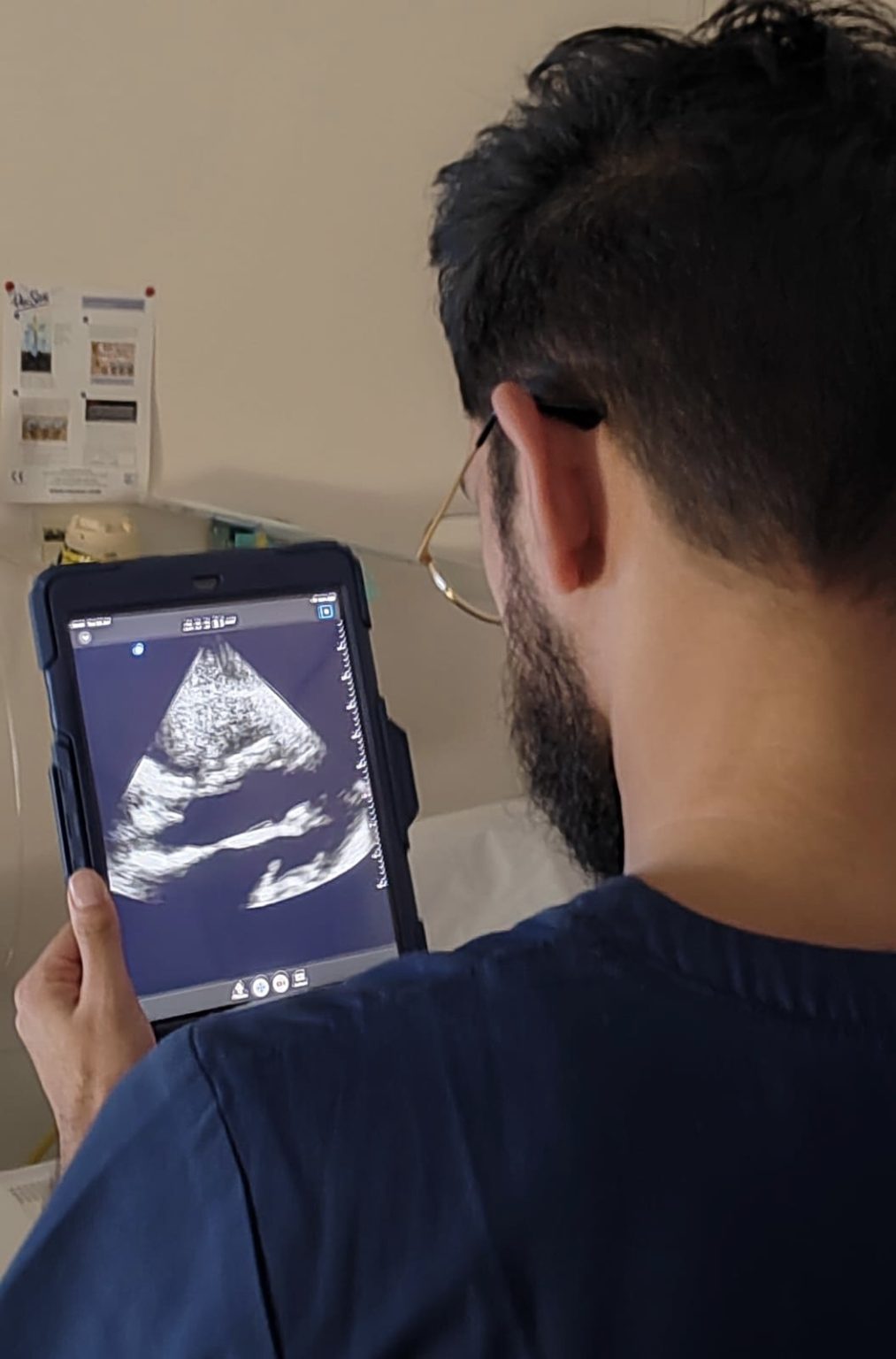
An individual doctor buying a $2,699 probe is making a personal purchase. No committee, no capital request. The content that moves them shows the device working.
That means bedside scans, unboxing clips, and specialty-specific use cases. Butterfly adds an education layer, including Butterfly Academy courses and a ScanLab practice app, so a curious clinician finds instruction, not a brochure.
When a product is genuinely demonstrable, the demo becomes the advertisement and every existing user becomes a distribution channel.
Seeding the install base does the rest. The University of Rochester Medical Center (URMC) issues incoming medical students a personal probe. In 2026 Butterfly signed a deal with the Edward Via College of Osteopathic Medicine worth more than $10 million over four years, placing an iQ3 with every incoming student.
Students who learn on your device become attendings who specify your device.
Track 2: The health system buys the spreadsheet
Enterprise buyers do not respond to unboxing videos. They respond to documented financial outcomes.
Since 2021 URMC has deployed 862 devices across 64 academic departments alongside Butterfly's Compass workflow software. The result was a 116% increase in ultrasound charge capture, with findings published in the Journal of Clinical Imaging Science.
The pitch to a health system is not better imaging. It is captured revenue from scans that previously went undocumented.
Why Does a Published Price Do So Much of the Selling?
A specific number is the most portable piece of content a device company owns. Nobody repeats a value proposition at a conference. They repeat that it costs about twenty-seven hundred dollars and plugs into a phone. That sentence travels through group chats and residency programmes with no media spend attached.
A published price also removes the discovery call from the top of the funnel, which is what a busy clinician wants and what most medtech companies still refuse to do.
The same logic applies to the mission statistic. 4.7 billion is memorable in a way that "expanding access to imaging" never will be. In our work with health tech founders, the most common gap we see is a deck full of usable numbers and a website full of adjectives.
What Results Has Butterfly's Strategy Produced?
The commercial results support the approach. Butterfly reported record second-quarter 2026 revenue of $32.6 million, up 39% year over year, with United States revenue up 57%.
- Gross margin of 71.4%, up from 63.7% a year earlier
- Full-year 2026 revenue guidance raised to $119 million to $123 million
- Software and services at $16.9 million, more than half of quarterly revenue
The credibility layer is separate and equally deliberate. The iQ3 won Best Medical Technology at the 2024 Prix Galien USA Awards, and Butterfly's technology has been recognised by TIME's Best Inventions, Fast Company's World Changing Ideas, and CNBC's Disruptor 50.
Awards are not vanity here. When a clinician risks personal money and patient outcomes, third-party validation is the shortcut past scepticism.
What Can Health Tech Founders Copy From This?
You do not need a semiconductor breakthrough to apply the structure. Separate your audiences and stop asking one asset to do two jobs.
- Write your mission as a number, not an adjective. Use a figure a reader can repeat from memory.
- Publish your price if the product supports self-serve adoption. Hiding it filters out the grassroots users who create demand for the enterprise deal.
- Build the demonstration before the deck. A forty-second clip of the product working outperforms most whitepapers.
- Keep a separate ROI asset for institutional buyers. Named institution, measured outcome, published where procurement can find it.
- Seed training environments. Medical schools, residency programmes, and EMS fleets create tomorrow's specifiers.
Unlike the common advice that medtech should lead with clinical validation and let commercial adoption follow, Butterfly ran the sequence in reverse. It won individual users first, then published the enterprise evidence those users generated.
Tempus AI scaled on a comparable split between clinician-facing evidence and enterprise proof, as our analysis of the health tech marketing strategy behind Tempus AI shows. The formats differ. The architecture does not.
Butterfly's advantage is that its product is visible. Most deep tech is not, and that constraint changes the playbook, as our breakdown of deep tech video marketing across four companies explains.
Where This Leaves You
The hardest problem in medical device marketing is rarely the technology. It is showing a clinician why they need it before they have held it.
At Alluvium Media we build two things for health tech founders. Explainer and mechanism animations that make your technology legible in under ninety seconds, and short-form clinical content that reaches doctors on the platforms they already use. See the work in our case studies, and our guide to video marketing for health tech startups covers the formats in detail.
If your device deserves more attention than it is getting, book a call with our team.

Frequently Asked Questions