Deep Tech Video Marketing: 4 Playbooks From Real Companies
Deep tech video marketing is the use of film to make complex, invisible, or unfinished technology understandable to investors, regulators, customers, and future employees.
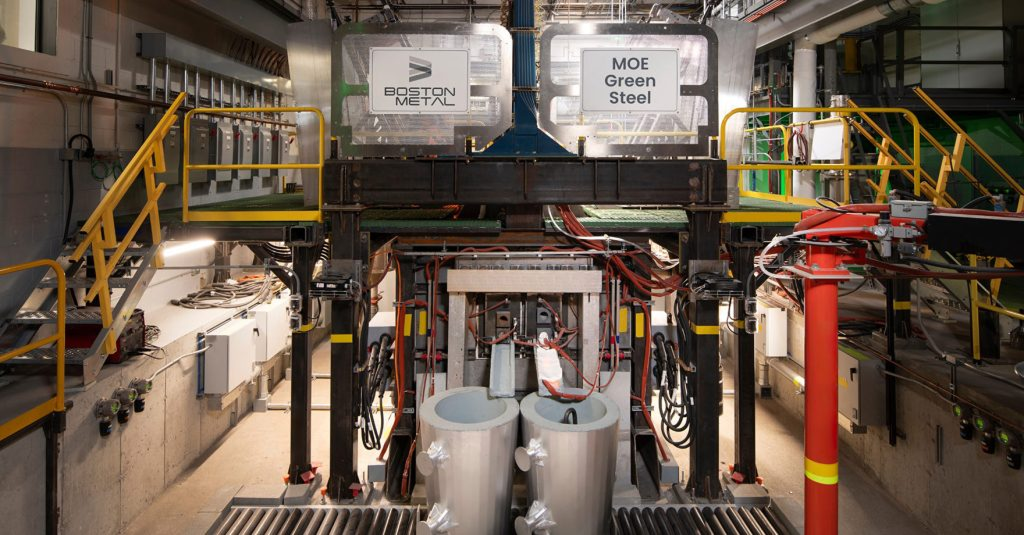
The problem is structural. Fusion plasma, direct air capture, clinical AI, and grid-scale batteries share one flaw: nobody can watch them work. A photograph of a grey steel enclosure tells a buyer nothing.
Four companies solved this in four different ways. Commonwealth Fusion Systems, Climeworks, Tempus AI, and Form Energy sell to entirely different audiences, yet each arrived at the same underlying answer.
Here is what each one does, and the single pattern connecting all four.
What Is Deep Tech Video Marketing?
Deep tech video marketing is the practice of using documentary footage, founder explanation, facility access, and data visualization to build trust in technology buyers cannot evaluate by looking at it. It replaces the product demo that hardware, biotech, and energy companies do not have.
The constraint shapes everything. When your product is a physics result, a dataset, or a plant that will not exist until the 2030s, the video cannot show the product. It has to show proof the product is real.
How We Selected These Four Companies
We looked for companies where the technology is genuinely invisible, the buying audience is small and expert, and the content approach is documented publicly rather than inferred.
- Each has raised at least $400 million, so the strategy survived investor scrutiny
- Each sells to a different audience: policymakers, consumers, clinicians, utilities
- Each has published video work we can point to rather than describe secondhand
- Together they cover fusion, carbon removal, health tech, and energy storage
1. Commonwealth Fusion Systems: Documentary Footage Over Renders
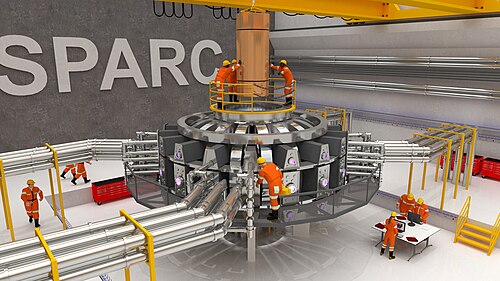
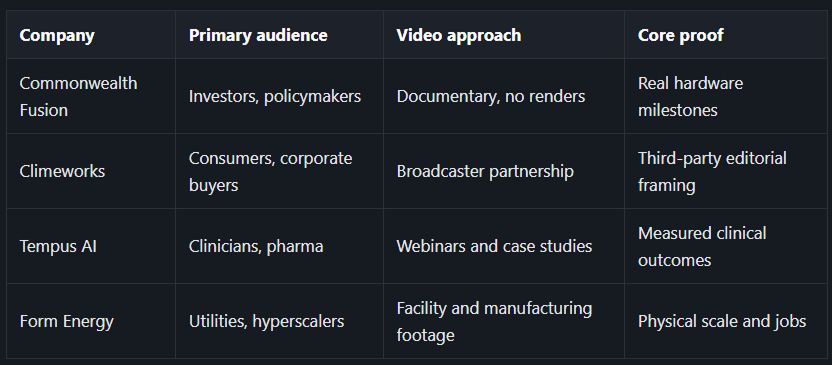
Commonwealth Fusion Systems built its brand on a rule that sounds like a restriction and works like a moat. Its imagery is primarily documentary, showing what is currently happening or already real, rather than CGI visions of a finished power plant.
Its brand agency Supermoon states the reasoning plainly. In a bleeding-edge industry with many hype merchants, CFS leadership understands the need to avoid the perception of overpromising while reinforcing credibility as category leader.
That decision carries a commercial payoff. CFS has raised over $2 billion, employs more than 1,000 people, and in July 2025 signed the first corporate fusion power purchase agreement in history, supplying Google with 200 MW.
The lesson for anyone marketing a product that does not exist yet: renders promise, footage proves.
2. Climeworks: Borrowing a Broadcaster's Credibility
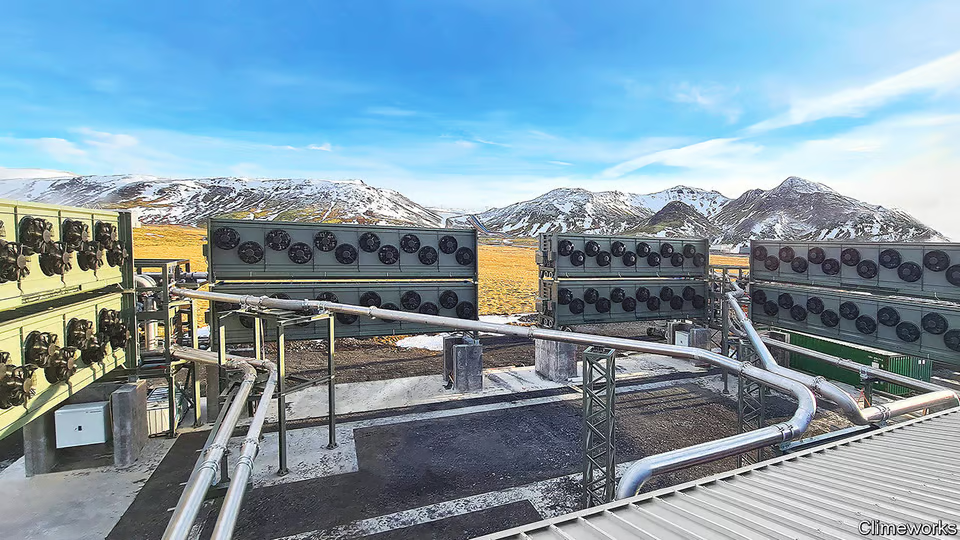
Climeworks took a different route. Rather than building an audience from zero, it borrowed one.
The film "Climeworks: Removing CO2 from the air" was produced by BBC StoryWorks, the branded content studio of BBC Studios, as part of a 30-film documentary series called Humanising Energy presented by the World Energy Council.
The strategic value is not production quality. It is the frame. A film sitting inside a BBC Studios series carries editorial credibility a company-produced video cannot buy directly.
Co-CEOs Jan Wurzbacher and Christoph Gebald appear in it explaining the path to gigaton scale. The same logic drives how Climeworks built a consumer brand for carbon removal: put credible third parties between your claim and your audience.
3. Tempus AI: Making the Data the Narrative

Tempus AI sells to oncologists, and oncologists do not respond to brand films. So Tempus built a content library that behaves like a medical education resource.
Its site organizes video and webinar replays by specialty and by audience, splitting providers from life sciences buyers. The content leads with clinical evidence, named institutional partners, and case studies tied to measured outcomes rather than product claims.
Founder Eric Lefkofsky adds a second layer with long-form essays and quarterly letters explaining the technology in plain language. The origin story, founded in 2015 after his wife's breast cancer diagnosis, sits at the center without being sentimentalized.
Revenue reached roughly $1.27 billion in 2025, up about 80% year over year. For technical buyers, the format of your content signals seriousness as much as the content itself.
4. Form Energy: Turning the Factory Into the Proof
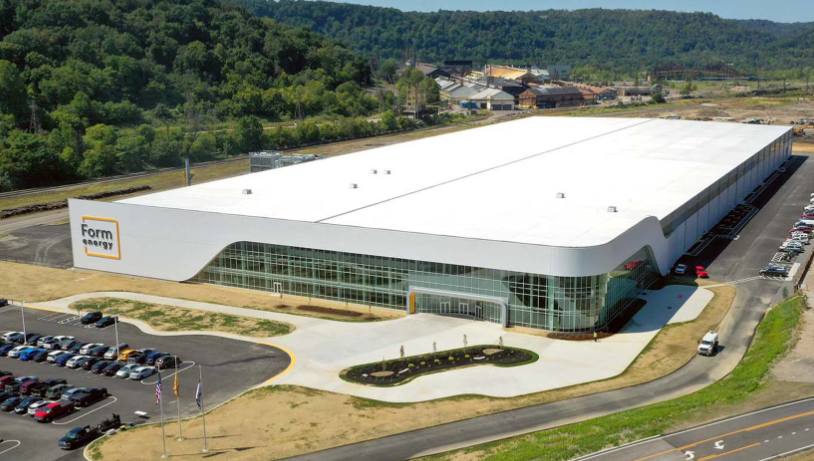
Form Energy builds iron-air batteries that store electricity by rusting iron. The technology is undramatic and the buyers are utilities, which makes conventional brand storytelling useless.
So Form Energy made the factory the story. Form Factory 1 occupies 550,000 square feet on a former steel mill site in Weirton, West Virginia, with up to $760 million in direct investment.
Physical scale does work a spec sheet cannot. A building you can film, walk through, and count workers inside is evidence the technology has left the lab.
We break this down further in our analysis of how Form Energy markets a battery made of rust.
How Do the Four Approaches Compare?
Each company matched its format to its buyer rather than to its budget. The table below maps audience against approach.
What Pattern Do All Four Share?
None of these companies use video to explain what their technology does. They use video to prove it exists.
Unlike the common advice to simplify complex technology through animation, the evidence here points the other way. Explanation can be faked with a render and a confident voiceover. Existence cannot. A magnet being lifted, a fan array running in Iceland, a physician describing a case, a factory floor with people on it: each is a claim a viewer can check.
In our work with climate tech and health tech founders, this is the most common gap we see. Companies commission an animated explainer when the buyer wants a camera pointed at the real thing.
There is a second shared trait. None treat video as a campaign with an end date. Each publishes continuously as milestones and facilities arrive, so the content compounds instead of expiring.
How Do You Choose the Right Playbook?
Pick the playbook matching your audience, not the one with the highest production value.

Start with these five steps
- Identify the single hardest claim a skeptical buyer would challenge
- Find the physical thing that proves that claim: hardware, facility, dataset, or result
- Film it as it is, without renders, staging, or stock footage
- Put your founder or lead engineer on camera explaining the mechanism
- Publish on a milestone cadence rather than a campaign calendar
Where This Leaves You
At Alluvium Media, we build video content for deep tech, climate, and health tech founders whose technology is genuinely hard to see.
We film founders, capture facility and lab footage, and turn a single session into the explainer, the investor cut, the conference reel, and the clips your sales team sends. You can see the work in our case studies.
Every company above reached the same conclusion independently. If nobody can see your technology working, your job is not to describe it. It is to show them something real.
If that sounds like your problem, book a call with our team.

Frequently Asked Questions