
Health Tech Marketing Strategy: How Tempus AI Built a $10B Company by Letting Data Tell the Story
Here is the short answer. Tempus AI's health tech marketing strategy works because it almost never talks about the product. Instead of selling genomic tests, the company sells stories: cancer patients whose treatment changed because of data. It markets to two audiences at once, oncologists and pharmaceutical companies, and it treats research, founder visibility, and AI as marketing channels. The result is a precision medicine company that went public in 2024 and grew into a business worth roughly $10 billion.
Most health tech founders think marketing means explaining the technology. Tempus does the opposite. It hides the technology and shows the human result. That single choice is why its playbook is worth studying.
Who Tempus AI Is, and Why It Matters
Tempus AI is a precision medicine company that uses genomic sequencing and AI models to help doctors match cancer patients to the right treatment. That is the entity in one sentence, and the whole marketing strategy grows out of it.
Founder Eric Lefkofsky, who also co-founded Groupon, started the company after his wife received a breast cancer diagnosis and he saw how little data guided her care.
The company went public on the Nasdaq in June 2024 under the ticker TEM. It reported roughly $1.27 billion in revenue for 2025, about 83% growth year over year, according to its full year results, and its market value has since climbed past $10 billion.
Here is the number that matters most for marketers. In its IPO filing, Tempus said it was connected in some way to more than half of all oncologists practicing in the United States. That reach was not bought with ads. It was earned with a very specific content strategy.
The Core Move: Sell the Outcome, Not the Test

Tempus leads with patient outcomes, not product features. Walk through its blog and newsroom and you rarely see a test being pitched. You see a person whose tumor was sequenced, whose doctor found a mutation, and whose treatment changed because of what the data revealed.
The test is in the story, but it is never the hero. The patient is the hero, and the data is the plot.
This is the lesson for founders. People do not buy genomic sequencing. They buy a better chance at living. Tempus markets the chance, not the machine.
That framing also does something clever for a technical product. It turns intimidating science into an emotional, easy to follow narrative that a nervous patient, a busy doctor, and a skeptical investor can all understand in the same minute. Climeworks used the same storytelling move in climate tech, which we broke down in our look at carbon capture marketing.
Marketing to Two Very Different Buyers
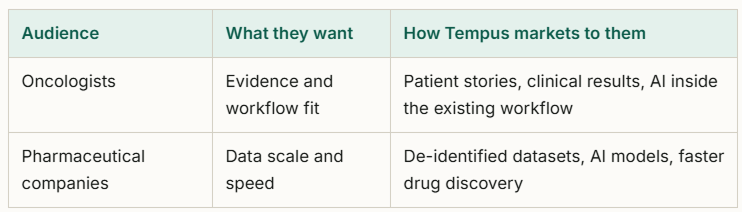
Tempus sells to two audiences at once, and it speaks to each in a different language. Most companies pick one. Tempus built its content so the same science reads as better care to doctors and as faster research to pharma.
Audience One: Oncologists
Doctors respond to evidence and workflow, not hype. So Tempus positions its AI as something already embedded in the clinical workflow, not a futuristic add on. The message is quiet and practical: this fits into how you already work, and it makes your decisions sharper.
Trust is the currency here. Every patient story, every research collaboration, and every clinical result is really a trust signal aimed at the physician.
Audience Two: Pharmaceutical Companies
Pharma is where a large share of the money sits. These companies pay Tempus to license de-identified data and build models that speed up drug discovery.
Tempus reported data agreements with more than 70 clients in 2025, including names like AstraZeneca, Pfizer, Merck, and Novartis. For this audience, the marketing is about scale, data depth, and results, not patient emotion.
Reaching two audiences also means choosing the right platform for each, a trade-off we cover in TikTok vs LinkedIn for health tech founders.
The Three Plays Behind the Strategy
Three repeatable plays sit under the storytelling, and any founder can borrow them.
Play One: The Founder Is the Channel

Lefkofsky is the marketing channel, not a hidden executive. He appears at major investor events like the J.P. Morgan Healthcare Conference and in fireside chats that work as marketing moments, not just finance updates.
Every appearance repeats the same story: AI is already changing cancer care, and Tempus is the company doing it. A visible, story driven founder is one of the cheapest and most powerful assets a health tech company has. We explain how smaller teams can do this in our guide on founder-led video.
Play Two: Research Is Marketing
Tempus turns research into brand building. It runs collaborations with major medical centers, including NYU Langone and Northwestern Medicine, and it launched the PRECISION Challenge, a national program that gives researchers access to its data, AI models, and grant funding.
On paper these look like science initiatives. In practice they are also marketing. Each partnership plants the Tempus name inside the most credible rooms in medicine. For a founder, a research collaboration is a trust engine and a marketing engine at the same time.
Play Three: AI as Reality, Not Buzzword
Tempus shows AI doing a specific job instead of claiming to be AI powered. It points to AI reading a tumor, flagging a care gap, and supporting a real decision at the point of care. Specific beats buzzword every time.
That specificity is also why AI search tools and journalists quote Tempus so often. Concrete claims are easy to cite. Vague ones get ignored. When your content states clear facts, real numbers, and named results, both Google and AI answer engines can pull you into their results.
What Health Tech Founders Can Steal From This Marketing Strategy
You do not need a billion dollar budget to use the Tempus health tech marketing strategy. You need discipline about what you put in front of people. Here is the short list:
- Lead with the patient, not the product. Show the outcome, and let the technology sit in the background.
- Map your content to each buyer. The story that moves a clinician is not the story that moves a pharma partner or investor.
- Put your founder on camera. Their story is your most repeatable marketing asset.
- Turn research and results into content. Every study, pilot, or collaboration is a trust signal worth publishing.
- Be specific about your AI. Show the exact job it does, not the category it belongs to.
The through line is simple. Tempus grew by letting real data and real people carry the message, while the hard science stayed in the background doing the work.
If you are a health tech founder trying to turn complex science into content that patients, doctors, and investors actually watch, that is the exact problem we help solve at Alluvium Media. See our approach to video marketing for health tech startups, then book a call with our team to build a story first strategy that fits your niche.

Frequently Asked Questions