

Deep Tech Marketing: How to Build Demand When Your Product Doesn't Exist Yet
Deep tech marketing is the work of building trust, talent, and customer demand for a product that is still years from existing. For pre-revenue startups in fusion, climate, biotech, and hardware, you cannot run a demo or share a customer case study. You market the mission, the milestones, and the team racing to get there.
The clearest live example right now is Commonwealth Fusion Systems (CFS). The company has raised close to $3 billion, signed a power deal with Google, partnered with Nvidia, and shared a CES 2026 keynote stage. It has done all of this without selling a single watt of commercial fusion energy.
So how do you market something that does not exist yet, without sounding like a hype machine? Below we break down exactly what CFS did, and how your deep tech startup can copy the same playbook.
Why Pre-Revenue Deep Tech Marketing Is Different
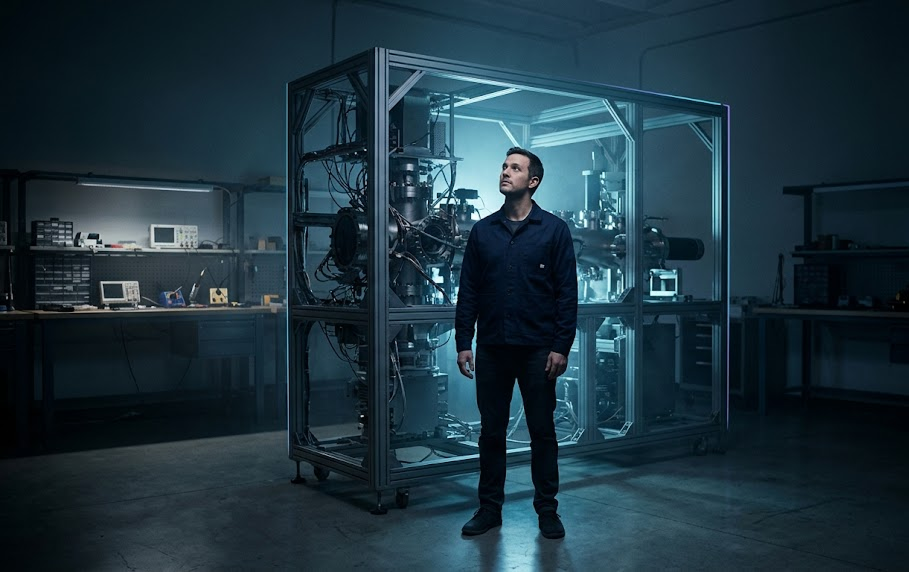
Most marketing advice assumes you already have a product to sell. Pre-revenue startup marketing flips that. Your real product is belief: belief that you will hit the next milestone, and the one after that.
That changes who you are talking to. Long before customers, you are marketing to investors, future hires, policymakers, and partners. Each of them is quietly asking the same question: is this real, or is it just a pitch?
Deep tech makes that question harder. The science is complex, the timelines are long, and the field is crowded. The Fusion Industry Association has counted more than 50 private fusion companies that have raised over $9 billion combined, so even a leader has to prove it stands apart.
Win trust in that environment and capital, talent, and customers tend to follow. Silence, by contrast, reads as risk.
How Commonwealth Fusion Systems Markets a Product That Doesn't Exist Yet
CFS spun out of MIT in 2018 with one goal: build the first commercial fusion power plant. Its demonstration machine, SPARC, is roughly 70% built and is expected to reach net energy around 2027.
In other words, the actual product is still years away. Yet the company already looks and sounds like the category leader. The whole playbook comes down to one idea: proof over promises.
1. Documentary footage, not glossy renders

It is tempting to sell the future with slick CGI: a gleaming reactor, clean animation, an imagined skyline. CFS mostly does the opposite.
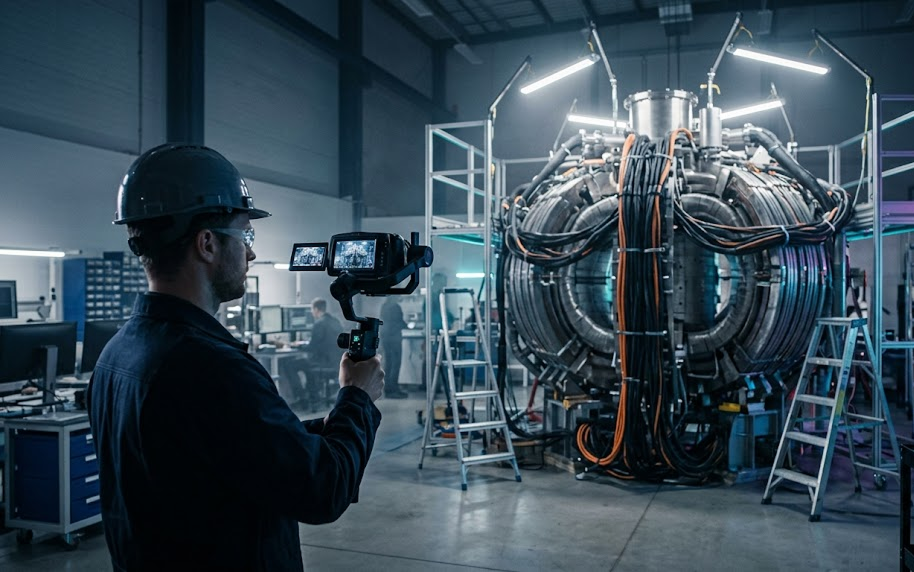
Working with brand agency Supermoon, CFS built a visual approach that is primarily documentary, showing what is actually happening or already real. Real magnets. Real factory floors. Real engineers.
There is a strategic reason for this. In an industry full of hype, real footage signals that the progress is genuine. Showing the work is more believable than promising the result.
It also gives the brand a backbone. CFS pairs that documentary look with one confident line, "Humanity's power move," so the message stays ambitious without drifting into fantasy.
For your startup, this means filming the lab, the prototype, the failed test, and the small win. In our experience, honest behind-the-scenes footage almost always out-converts a polished render of something that is not built yet. It is also the kind of video that drives real pipeline for technical companies.
2. Put the founder on camera
Deep tech is hard to trust because it is hard to understand. People bridge that gap by trusting a person, not a press release.
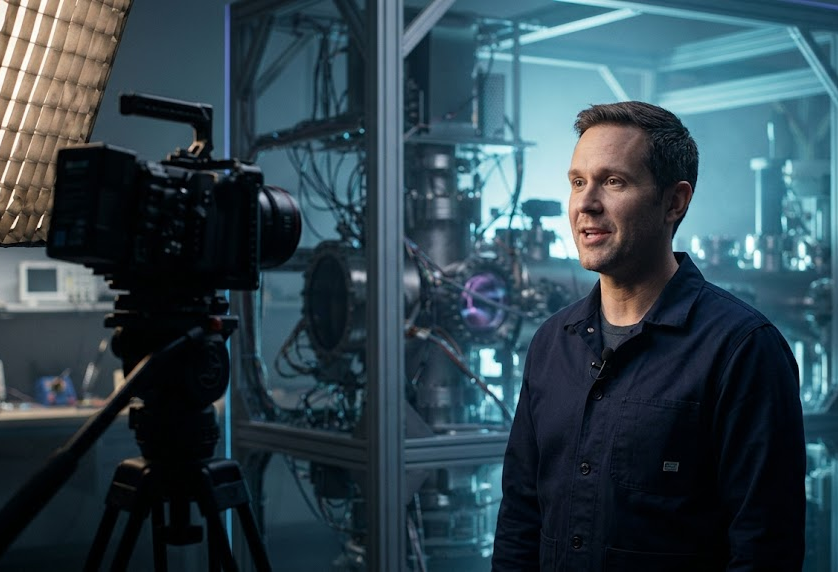
CFS CEO Bob Mumgaard is consistently the face of the company. He records regular video updates, gives interviews, and in January 2026 joined the CES opening keynote stage with the CEO of Siemens to tell the fusion story to a mainstream tech audience.
A visible, credible founder does something marketing cannot fake. It puts a human being behind an audacious claim and says, plainly, I am betting my reputation on this.
You do not need a keynote slot to start. A founder explaining one real update on camera builds more trust than a month of faceless company posts. This is the heart of founder-led video, and it works even if you hate being on camera.
3. Tell the story in milestones
When the finished product is a decade out, you cannot wait a decade to have something to say. CFS solves this with milestone-based storytelling.
Every concrete step becomes a story. Installing the first magnet. Closing a funding round. Signing a power deal. Each one is proof that the timeline is moving forward, not slipping backward.

This works for two reasons. It gives you a steady drumbeat of real news, and it trains your audience to measure you by progress instead of promises.
Map your own milestones now: a prototype, a pilot, a patent, a key hire, a new partner. Then build one short piece of content around each. Momentum is a story you can tell long before the product is finished.
4. Earn credibility through partners and proof
CFS rarely just claims it is the leader. It shows receipts. Google signed a 200 megawatt power purchase agreement for fusion that does not exist yet, its first commercial fusion commitment. The Italian energy company Eni committed more than $1 billion. Nvidia and Siemens joined in to build a digital twin of the machine.
Each partnership is borrowed trust. When names like Google and Nvidia attach themselves to your mission, skeptics start to wonder whether they are the ones who are wrong. The Nvidia and Siemens work is not just a logo either. It lets CFS simulate the reactor and compress years of testing into weeks, which is its own story worth telling.
You may not land Google. But a respected advisor, a university lab, a pilot customer, or a known investor plays the same role at your scale. Specific proof beats confident adjectives every time.
5. Avoid hype in an industry built on it
Fusion has been "30 years away" for half a century. CFS knows it, so its messaging leans on dates, numbers, and named milestones instead of vague world-changing language.
That restraint is the brand. It is why serious investors and reporters treat the company as credible rather than as another moonshot. For climate and energy startups, this is the same discipline behind learning to avoid greenwashing: say less, prove more.
The takeaway is simple. In a noisy category, the calm and specific voice wins. Overpromising is the fastest way to lose the exact people you are trying to convince.
How to Apply This to Your Deep Tech Startup

You do not need a billion dollars to use this playbook. You need to document reality, then tell it well.
Start with three moves. Film what is actually being built, even on a phone. Put your founder on camera explaining one real update. Then turn each milestone into a short, honest video.
Do that consistently and you stop sounding like a company waiting to launch. You start sounding like one that is clearly, visibly on its way. The same approach carries over when you need a sharper investor story for your next raise.
That is the exact work we do at Alluvium Media: documentary-style video storytelling for deep tech, climate, and health tech founders who are marketing the future before it ships.
If your product is still being built and you want your story to sound as credible as your science, book a call with our team and we will map the videos worth making first.

Frequently Asked Questions


.png)