Startup Pitch Video: What Investors Actually Want to See (2026 Guide)
A startup pitch video is a short, structured video (typically 60 to 120 seconds) that communicates your problem, solution, traction, and ask to potential investors. According to Wyzowl's 2024 Video Marketing Report, 89% of people say watching a video has convinced them to take action. For founders, a well-made pitch video is now one of the highest-leverage tools in a fundraising campaign.
Here is exactly how to make one that works.
Why Most Pitch Videos Fail Before the 10-Second Mark
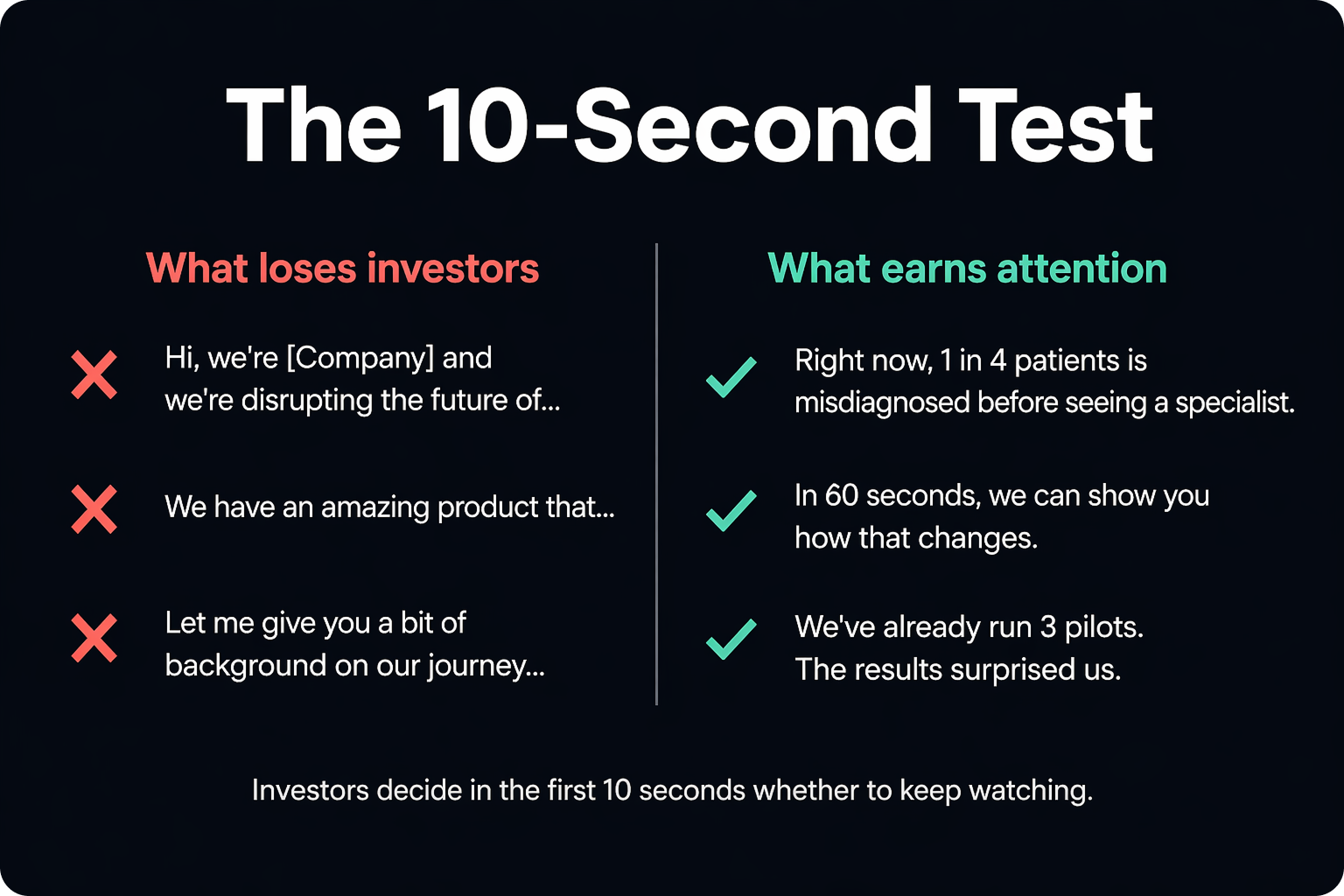
Investors watch hundreds of pitch decks and videos every month. If your opening line is "Hi, we're [Company], and we're revolutionizing the future of..." you have already lost them.
The first 10 seconds are your entire pitch compressed into one moment. Lead with the pain. Make the viewer feel the problem before you offer the solution. That contrast is what creates tension, and tension is what keeps someone watching.
The Structure That Actually Converts
There is no mystery to what investors want from a startup pitch video. They need answers to five questions, in this order.
(i) What is the problem, and who suffers from it?
Be specific. "Patients in rural clinics wait 3 weeks for a diagnosis that takes 20 minutes with our device" is infinitely stronger than "healthcare is broken."
(ii) What is your solution, and how does it work?
Show it. A 5-second screen recording of your app or a quick shot of your product in use does more than 30 seconds of you explaining it.
(iii) Why now, and why you?
This is where you earn credibility fast. A stat, a patent, a pilot result, or a founder credential that makes the viewer think: these people are the right team for this.
(iv) What is the traction?
Numbers only. Revenue, users, partnerships, pilots. Skip the adjectives.
(v) What is the ask?
State the raise amount and what it unlocks. Be direct. Vague CTAs kill momentum.
The Production Details That Signal Credibility
Your video does not need to be cinematic. But it does need to look intentional.
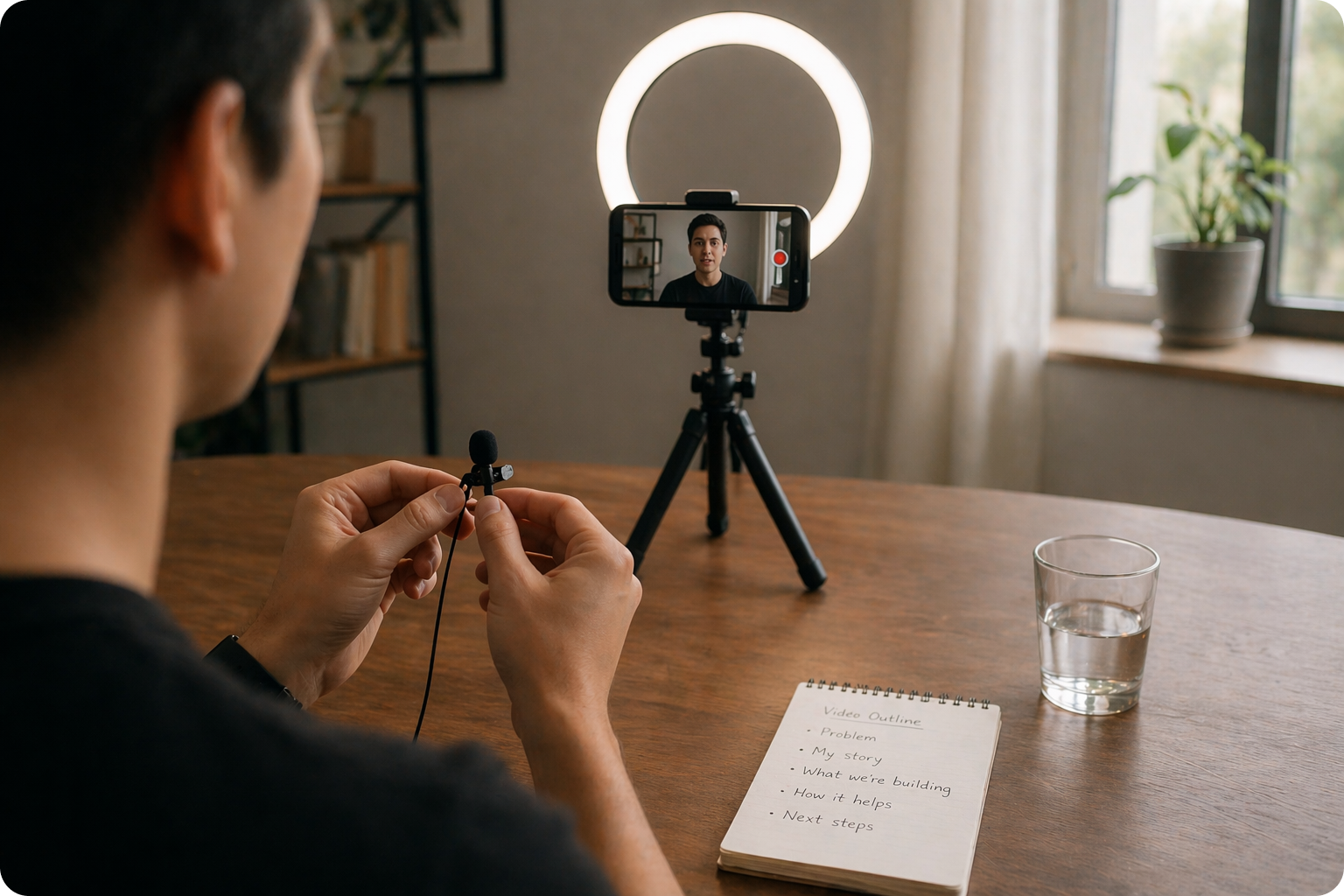
Audio is non-negotiable. Bad audio reads as careless. A $30 lapel mic fixes this entirely. Invest there before anywhere else.
Lighting matters more than your camera. Natural light from a window, or a single ring light, is all you need. Shadows on your face create visual noise that distracts from your message.
Keep it under 2 minutes. For pre-seed and seed rounds, 60 to 90 seconds is the sweet spot. If you are Series A or beyond and pitching to larger funds, you can push to 2 minutes. Beyond that, you are losing people.
Add captions. Many investors watch on mute during commutes or between meetings. If they cannot follow along silently, they will not follow along at all.
Where Founders Get This Wrong
The most common mistake is treating the pitch video like a product demo. It is not. It is a story about a market, a problem, and a team.
The second most common mistake is over-scripting. Investors are buying into you as a founder. If you sound like you are reading a teleprompter, that trust evaporates. Speak naturally. Use notes if you need to, but not a word-for-word script.
If you struggle with on-camera delivery, we have written specifically about that in our guide on founder-led video and why being on camera matters.
Where to Use Your Pitch Video Once It Is Made
Most founders film a pitch video and only use it in a single deck. That is a significant missed opportunity.
Embed it in your cold investor emails. Post a cut-down version on LinkedIn. Add it to your AngelList or Crunchbase profile. Use it at demo days. The same 90-second video can work across every touchpoint in your fundraising process, which means the production effort pays back many times over.
For a broader look at how to build a multi-channel video strategy around your fundraise, see our B2B video marketing strategy guide for founders.
How to Film a Pitch Video That Does Not Look Like Everyone Else's
The structural advice for pitch videos is now widely available. The harder problem is differentiation. Investors watch hundreds of pitch videos that follow the same structure, hit the same beats, and sound nearly identical. A video that follows the formula correctly but does not stand out will be forgotten within 48 hours.
Here is how to build differentiation into the production itself, not just the script.
Open with a scene, not a statement. Instead of starting with you talking to the camera, open with 5 to 10 seconds of footage that immediately communicates the scale or reality of the problem you solve. A climate tech founder might open with 8 seconds of footage from an industrial facility before ever appearing on screen. A health tech founder might open with a real statistic displayed as a full-screen graphic before saying a word. Scene-first openings create context before the pitch begins, which makes everything that follows more resonant.
Use one specific story, not a category description. The strongest pitch videos are built around one specific customer, one specific situation, or one specific moment that illustrates the problem. "One in three rural patients waits over three weeks for a specialist referral. We built our product because of one patient who waited six weeks for a diagnosis that took us 11 minutes" is infinitely more memorable than "healthcare access is a significant challenge in underserved communities."
Show something real in the middle. Not slides. Not animated graphics. Something real: your interface working, a pilot site, a real team member, a data output from your system. Investors are pattern-matching for realness. One piece of footage that is obviously real and specific outweighs 30 seconds of polished animation in terms of credibility signal.
Close with your face. However the video opens, it should end with you on camera making a direct ask. Investors are making a bet on a person. Let the last thing they see be the person they are betting on.
These four production choices add minimal cost and time to your pitch video process. They add significant differentiation.
Ready to Build a Pitch Video That Gets Meetings?
We work with health tech, wellness, and climate tech founders to produce videos that move investors to act. From scripting to final cut.

Frequently Asked Questions