
AI vs. Human Video Production for Startups: Which One Actually Gets Results?
AI video production and human video production are not competing strategies for startups... they solve different problems. The startups winning with content in 2026 are using both deliberately: humans to capture what is real, and AI to make the complex visually compelling.
Most founders pick one side and underperform on both.
What AI Video Production Actually Does Well
AI video production gives startups a way to visualize what human footage cannot show on its own.
This is where AI genuinely adds value:
- Bringing abstract concepts to life. If your product involves data pipelines, molecular processes, climate systems, or software infrastructure, AI-generated visuals can show it in seconds. No animator required.
- Producing concept-driven scenes. Scenarios that would require expensive sets, equipment, or locations can be built visually with AI. You get the visual without the shoot.
- Explaining the intangible. For health tech and climate tech founders especially, the core value proposition often lives in a process or mechanism the camera cannot capture. AI closes that gap.

According to Wyzowl's 2024 Video Marketing Report, 96% of people watch an explainer video to learn more about a product or service. If your product is hard to explain, AI visuals are not optional.
Where Human-Led Video Still Dominates
Human video production builds the trust that AI cannot manufacture.
Human-led content wins in these areas:
- Founder stories and on-camera credibility. A real person speaking directly to camera builds trust faster than any polished production. Audiences feel the difference between authentic and assembled.
- Client testimonials and case studies. Social proof requires real faces, real voices, and real context. AI cannot replicate the weight of a genuine customer saying your product changed their outcome.
- Relationship-driven content. Health tech, wellness, and climate tech are trust-sensitive categories. Real people on screen signal transparency in a way AI visuals simply cannot.

The strategic rule: Human footage earns trust. AI visuals earn understanding. Both are required for a startup content strategy that converts.
The Hybrid Model: What the Best Startup Content Teams Are Doing
The most effective startup video strategies in 2026 are not choosing between AI and human. They are building a system where each format does what it is built for.
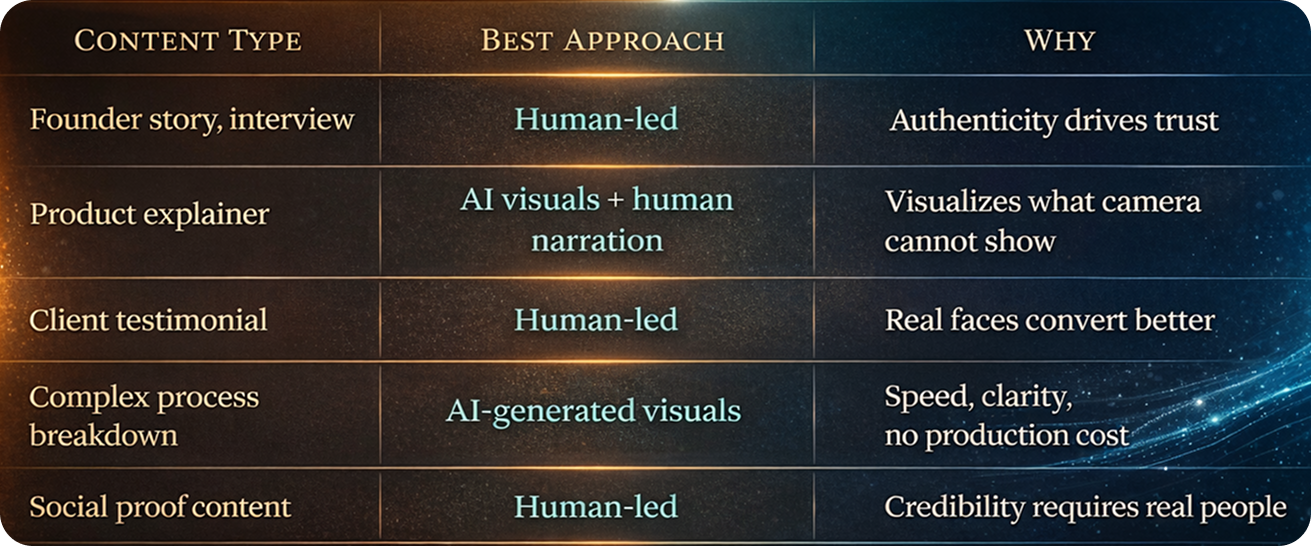
The pattern is clear: use human footage for moments that need to feel real, and AI visuals for concepts that need to be seen.
How to Evaluate AI Video Output Before It Represents Your Brand
One of the practical challenges founders face when integrating AI video into their content strategy is knowing how to evaluate the output before it goes public. AI-generated visuals can look compelling in isolation and still create problems in context, particularly in regulated industries where accuracy and trust are non-negotiable.
A simple four-point review process eliminates most of the risk.
The first check is accuracy of representation. Does the AI-generated visual accurately represent what your technology does, or does it convey something more impressive or less realistic than the actual product? In health tech specifically, a visualized process that implies a capability the product does not yet have is a compliance and credibility risk. In climate tech, an AI-generated visual showing outcomes at a scale the technology has not yet achieved is a greenwashing risk.
The second check is claim alignment. Does the text or narration accompanying the AI visuals make claims that can be substantiated? Every specific claim in a video, whether spoken, captioned, or implied visually, needs to be traceable to real data or real outcomes. AI generation tools do not have this self-awareness. You do.
The third check is audience trust calibration. For health tech and climate tech audiences especially, AI-generated content that looks obviously artificial can trigger skepticism that undermines the message itself. Test your AI-assisted content with someone in your target audience before publishing. Their gut reaction to the visual style is meaningful data.
The fourth check is attribution clarity. If your video uses AI-generated visuals to represent data, processes, or outcomes, make sure the source of that underlying data is clearly stated somewhere in the accompanying content. AI tools can make your data look more polished. That is a feature. But the data still needs to be real and referenced.
Running these four checks before publishing any AI-assisted content takes 15 to 20 minutes per video. It is the discipline that separates founders using AI video effectively from those whose AI-assisted content creates more problems than it solves.
So What Should Your Startup Choose Right Now?
It depends on what your content needs to accomplish.
If your product is hard to explain: Lead with AI visuals to make the concept click. Layer in human narration to keep it personal.
If you are building investor or client trust: Prioritize founder-on-camera content and real testimonials. AI visuals support, not replace.
If you are in a regulated space like health tech: Always pair AI-assisted content with human oversight. Compliance and credibility are not worth trading for speed or scale.
If you are early-stage and budget-constrained: Start with human footage for the trust layer. Use AI selectively for concept visualization where your product genuinely needs it.
The goal is not to pick a side. It is to match the right format to the right job at every stage of your content.
At Alluvium Media, we work with health tech, wellness, and climate tech founders to build video strategies that use both. Our team handles strategy, scripting, and human-led filming. We use AI to make the concepts behind complex products actually visible.
If you want to see what that looks like for your startup, book a call with us.

Frequently Asked Questions