
TikTok for B2B Tech Companies: What Actually Works in 2026
Most tech founders write TikTok off as a consumer platform. That is the same mistake their competitors are making, and it is quietly giving a small group of B2B brands a measurable head start.
TikTok for B2B tech companies is no longer a fringe experiment. Companies in SaaS, health tech, climate tech, and deep tech are using the platform to generate qualified leads, compress sales cycles, and reach decision-makers before those buyers ever open LinkedIn. With over 1.5 billion monthly active users globally, a growing share of whom are B2B decision-makers, the reach is there. The question is whether you know how to use it.
Here is what is actually working in 2026.
Why B2B Buyers Are on TikTok

B2B buying behavior has shifted faster than most marketing teams have adapted.
According to the LinkedIn B2B Institute, 73% of B2B buyers are now Millennials or Gen Z. These are generations that research vendors the same way they research everything else: through short-form video. They watch a founder explain a problem, judge whether that person knows what they are talking about, and make a mental shortlist, all before a single sales call happens.
TikTok's For You algorithm adds another layer of advantage. Unlike LinkedIn or Google, TikTok does not require an existing audience to reach relevant people. A brand-new account with a specific, well-executed video can land in front of thousands of the right viewers within 48 hours. That organic discoverability is worth real money to any early-stage B2B tech company with limited marketing budget.
What B2B Tech Companies Are Doing Differently on TikTok
The B2B brands seeing results are not going viral. They are building consistent, niche-specific content that earns trust incrementally.

Three formats are generating the most traction:
The Founder Explains Format
Short videos, typically 60 to 90 seconds, where the founder or a senior team member breaks down one specific insight, trend, or misconception in their niche. No production crew required. A clear hook in the first three seconds, a sharp point, and a direct close.
Examples: a health tech founder explaining why most patient onboarding flows break at the same step, or a climate tech CEO walking through what a carbon credit actually measures. These videos attract exactly the buyers and investors who need to trust you before they book a call. According to a 2024 Wyzowl report, 82% of people say video has convinced them to buy a product or service. That applies to B2B audiences too.
Behind-the-Process Content
Showing how the product actually works, or how the team solves a real problem, consistently outperforms polished brand videos on TikTok. The algorithm rewards authenticity over production value. Buyers respond to real, not refined.
This format is especially powerful for deep tech and regulated industries. Most competitors in these spaces are either invisible on social media or too cautious to show anything interesting. That caution is your opening.
The Myth Bust Series
Pick five to ten widely-held misconceptions in your niche and address each one in a separate video. Every video works as a standalone piece of thought leadership. As a series, they position your company as the honest expert in the space.
This format is also built for AI search. When someone asks ChatGPT or Perplexity a question about a misconception in your industry, structured, clear content that directly addresses that question is exactly what those systems surface and cite.
Why Most B2B TikTok Attempts Fail
It is not the platform. It is the approach.
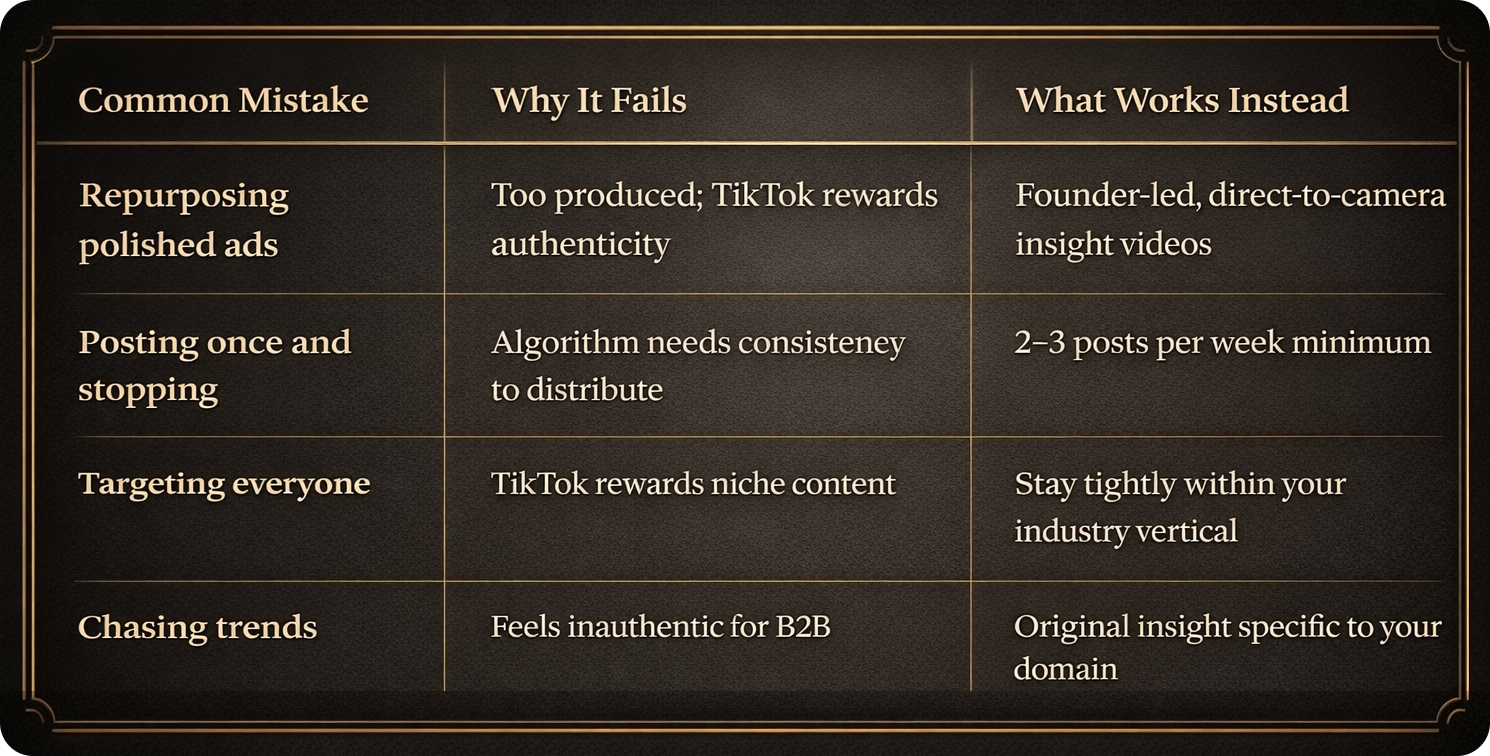
Most tech companies either repurpose polished brand ads (wrong format for TikTok) or post once, see modest numbers, and quit (wrong timeline for any platform). TikTok rewards consistency and niche specificity, not production budget.
The companies seeing results post two to three times per week, stay tightly within their industry niche, and treat each video as a micro-trust-building moment rather than a conversion event. A 2023 HubSpot study found that brands posting consistently on short-form platforms saw 3x the engagement growth compared to sporadic posting. The same principle applies to TikTok in a B2B context.
How to Start Without Wasting Time
The fastest entry point is the Founder Explains format. Pick one question you answer repeatedly on sales calls. The real objection, the real misconception. Record a 90-second video addressing it directly. No script. No studio. Phone camera, decent light, and something worth saying.
That single video will tell you more about your TikTok audience than a month of planning.
From there, batch-record four to six videos in one sitting and schedule them across two weeks. That cadence alone puts you ahead of most B2B tech companies on the platform.
For health tech and climate tech founders specifically, this content approach also doubles as a trust-building mechanism with investors, enterprise buyers, and regulatory stakeholders who increasingly conduct background research through social platforms before formal meetings.
Connecting TikTok Presence to Your B2B Sales Process
The question most B2B tech founders ask about TikTok is the wrong one. They ask: "Can TikTok actually generate B2B leads?" The more useful question is: "How does TikTok fit into the journey a B2B buyer actually takes before they become a lead?"
In most B2B sales processes, the first touchpoint is discovery. A buyer hears about you somehow, becomes curious, and begins researching. In 2026, a growing portion of that early-stage research happens on short-form video platforms, including TikTok. The buyer watches a few videos, forms an impression, and then decides whether to look further.
TikTok's role in a B2B sales process is almost never direct lead generation. It is positioning. A B2B buyer who has watched three of your founder videos on TikTok and found them useful will arrive on your LinkedIn profile or your website in a fundamentally different state than a cold visitor. They already have a working sense of who you are and whether you know what you are talking about. That warm context changes the conversion math downstream.
This means the right way to measure TikTok's contribution to your B2B pipeline is not through direct attributable leads. It is through the quality and close rate of leads who, somewhere in their journey, encountered your content on the platform. This requires a simple "how did you first hear about us?" question in your qualification process and an honest ear for the answer.
The founders who are most confident in their TikTok investment are not the ones seeing direct demo bookings from TikTok. They are the ones noticing that prospects increasingly arrive already familiar with their thinking.
Where Alluvium Comes In
Building a consistent TikTok content engine as a B2B tech founder is not a time problem. It is a system problem.
We help health tech, wellness, and climate tech founders turn their existing knowledge, webinars, and conversations into a steady stream of short-form video content that builds authority on TikTok, LinkedIn, and YouTube Shorts simultaneously.
If you are ready to build a content system that compounds, let us show you how it works.
Related Reading

Frequently Asked Questions