


How to Avoid Greenwashing in Climate Tech Marketing
Your climate solution is real. You have pilot data, emissions metrics, and validated results. But the moment you sit down to create marketing content, you hesitate.
You've seen what happens when climate companies overclaim. Glossy campaigns promising "carbon neutrality" with zero evidence. Startups claiming to "save the planet" while hiding the fine print. One careless phrase and suddenly investors are questioning everything you've built.
The solution isn't to stay quiet. It's to communicate with precision.
What Greenwashing Actually Looks Like
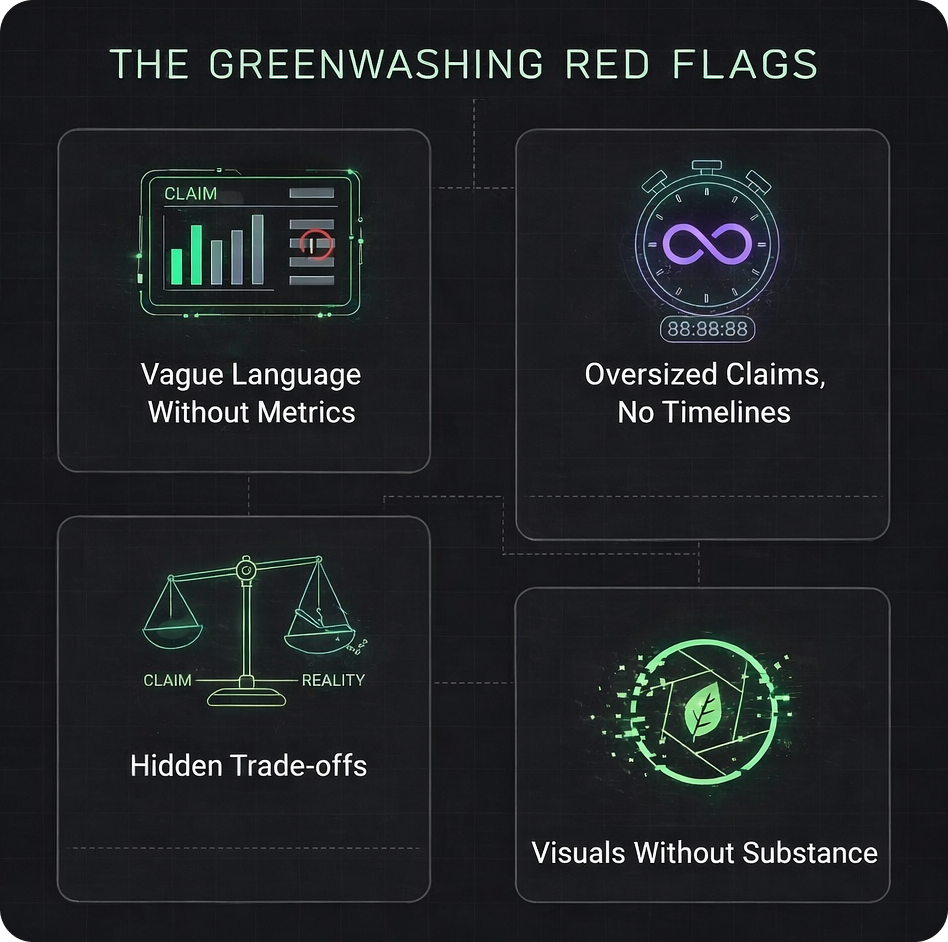
Before you can avoid greenwashing, you need to recognize it. These patterns trigger immediate skepticism from investors, partners, and anyone who evaluates climate solutions professionally.
Vague language without metrics:
Terms like "eco-friendly," "sustainable," and "green" mean nothing without numbers attached. When climate tech founders use these words without data, they signal either ignorance or intentional misdirection.
Oversized claims without timelines:
Statements like "We're solving climate change" or "Our technology will transform the industry" with no proof, no timeline, no mechanism. To anyone serious about climate, these read as pure marketing fluff.
Hidden trade-offs:
Every climate technology has constraints. Carbon capture works better at certain scales. Battery storage has efficiency limits. Pretending your solution has no downsides is a red flag that sophisticated buyers will catch immediately.
Feel-good visuals without substance:
Stock footage of wind turbines and solar panels while your actual technology sits unexplained. The disconnect between imagery and information is textbook greenwashing.
What Authentic Climate Messaging Looks Like
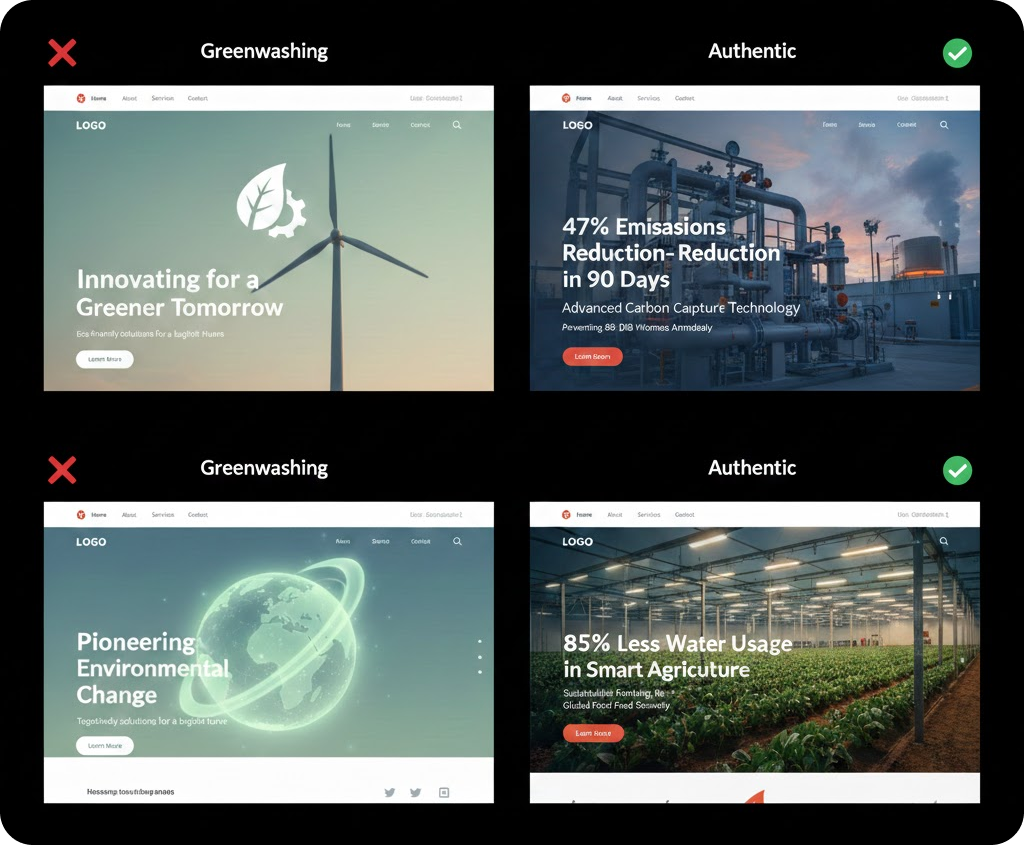
The climate tech founders who build real trust with investors and enterprise buyers flip the script entirely. They lead with complexity instead of hiding it.
Specific metrics replace vague claims:
Not "we reduce emissions" but "we reduce methane emissions by 47% in dairy operations within 90 days of deployment." Numbers build trust. Ranges are acceptable. Vagueness is not.
Honest timelines replace hype:
"We'll reach commercial scale by 2028" is more credible than "we're changing the world today." Investors respect founders who understand the difference between vision and current capability.
Transparent trade-offs signal maturity:
"Our solution works best in industrial settings above 10MW. Residential applications need another 18 months of R&D." This isn't weakness. It demonstrates the technical depth that serious investors look for.
Proof replaces promises:
Pilot data. Third-party validation. Customer results. Independent audits. Show the receipts.
The Framework That Works
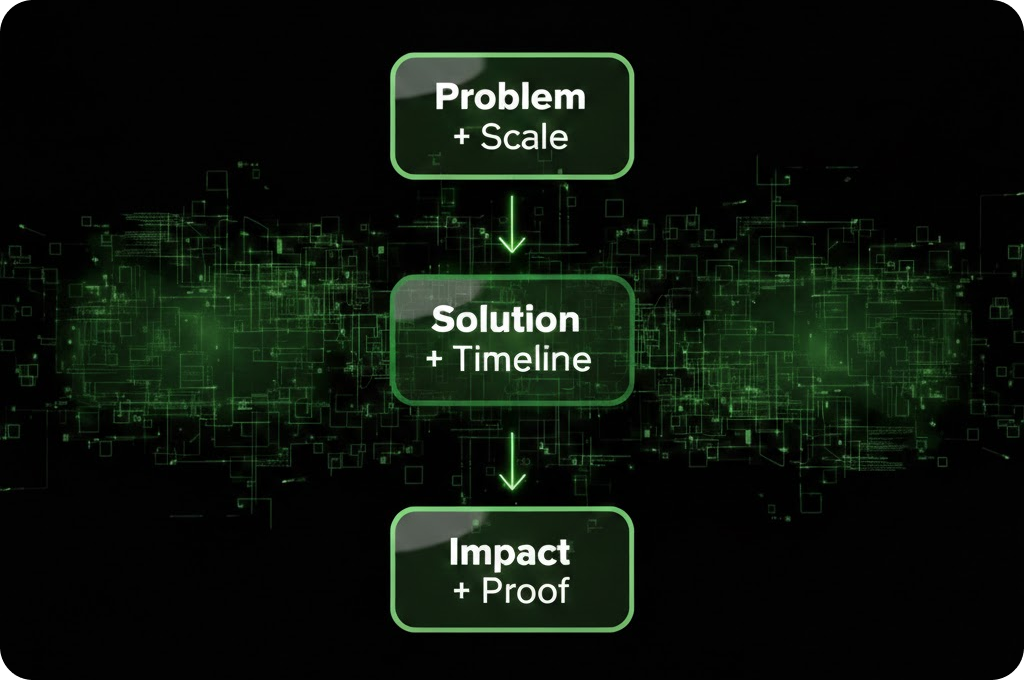
Climate tech founders who win attention without greenwashing accusations follow a simple three-part structure.
Problem + Scale:
Quantify the issue you're solving. "Industrial cooling accounts for 7% of global electricity consumption and 10% of global HFC emissions."
Solution + Timeline:
Explain what your technology does and when results happen. "Our thermal storage system reduces that energy consumption by 40%, with measurable ROI within 18 months."
Impact + Proof:
Data from real deployments. "Three pilot sites operational. Average customer savings of $2.1M annually. Independent audit available on request."
How Climate Tech Video Specifically Creates Greenwashing Risk
Most of the guidance on avoiding greenwashing focuses on written copy. But video introduces a specific set of risks that written content does not, because the visual layer creates impressions independently of what you say.
A climate tech founder can script a perfectly accurate, data-backed statement about their technology, film it in front of a lush green forest, and walk away with a video that registers as greenwashing to any sophisticated viewer. The mismatch between imagery and substance is itself a credibility signal. Investors and enterprise buyers who evaluate climate solutions professionally notice these things.
Here is where climate tech video specifically goes wrong.
Stock footage misalignment. Using generic wind turbine, solar panel, or clean water imagery while your product actually works at the industrial infrastructure or software layer creates a false visual impression. The solution is to use footage that actually represents your technology, even if that means filming at your pilot site, your lab, or simply in front of a plain background.
Vague visual captions. Text overlays that say things like "saving the planet" or "zero emissions future" without any data attached are the visual equivalent of a vague verbal claim. Every text element in your video is a marketing claim and needs the same scrutiny as your spoken words.
Emotional music without substance. Atmospheric soundscapes paired with beautiful landscape footage and minimal technical content is the most common production pattern that triggers greenwashing associations. Investors in particular are conditioned to flag this combination.
The EU's Empowering Consumers for the Green Transition Directive, which takes full effect in September 2026, bans generic environmental claims in consumer-facing communications across EU member states. For climate tech companies marketing to European enterprises or operating in regulated markets, this means video content now requires the same substantiation standards as any other marketing claim.
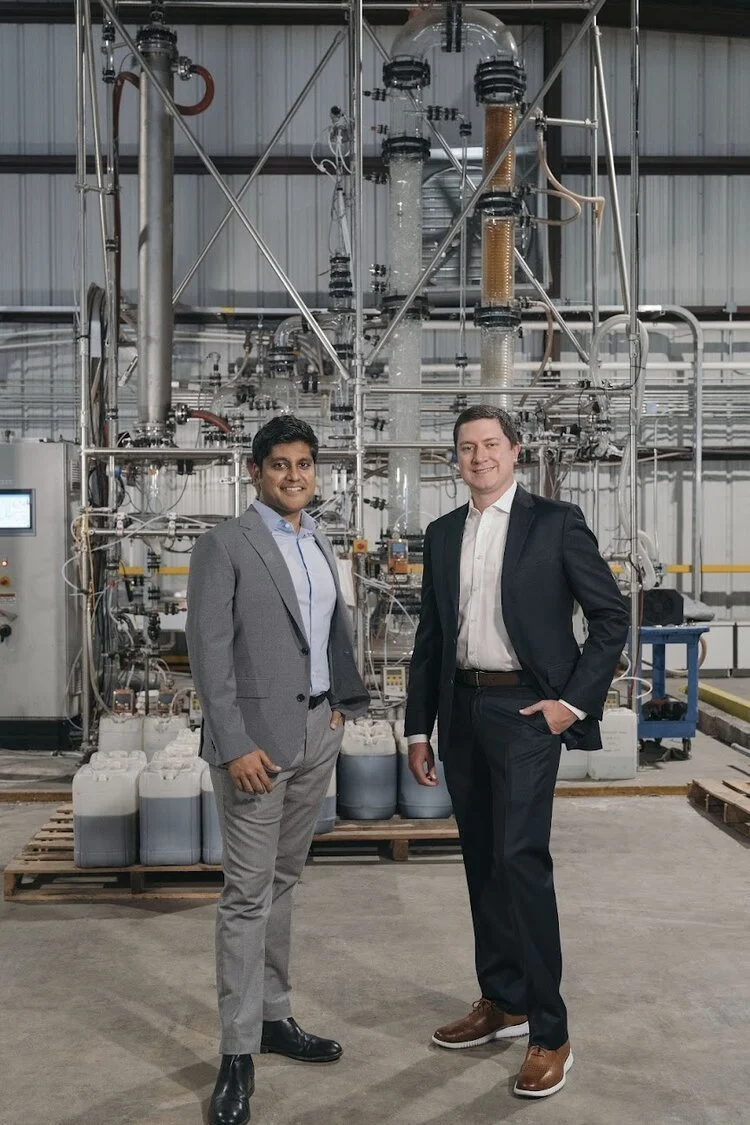
What authentic climate tech video production looks like is simpler than founders expect. It is a founder on camera, in a real operational setting, speaking specifically about what the technology does and backing those claims with data they can source. No atmospheric cutaways. No vague mission statements. Just credible specificity, which is precisely what both investors and enterprise buyers are looking for.
The founders who have figured this out are not producing less engaging content. They are producing more trustworthy content. In a category defined by skepticism, that distinction is the competitive advantage.
The Quick Checklist
Before publishing any climate tech marketing content, run it through these filters:
- Language audit: Remove every vague environmental term. Replace "sustainable" with specific outcomes.
- Claim verification: Can you prove every claim with data? If not, soften it or cut it.
- Trade-off transparency: Does the content mention at least one limitation? 100% positive reads as 100% marketing.
- Evidence check: Is there at least one specific data point, customer result, or third-party validation?
Pass all four and you're building credibility. Fail any and you're risking the greenwashing label.
The Bottom Line
Authentic climate tech marketing isn't about being modest. It's about being honest. Specific beats vague. Data beats promises. Transparency beats polish.
We help climate tech founders translate complex solutions into video content that builds investor trust instead of triggering skepticism.
If that's what you need, let's talk.

Frequently Asked Questions

.png)