Video Marketing for Climate Tech Startups: A 2026 Strategy Guide
Climate tech video marketing is how the fastest-growing cleantech startups are winning investor attention, closing enterprise deals, and building trust in 2026.
With $40.5 billion in climate tech VC funding in 2025 (up 8% year-over-year, per Sightline Climate) and EU anti-greenwashing rules taking effect this September, the startups that win are the ones who explain what they do clearly, credibly, and fast.
Why Video Matters for Climate Tech Startups in 2026
Climate solutions are complex. You are selling carbon capture, grid-scale storage, or regenerative agriculture to people who need to understand it before they fund it.
91% of businesses now use video as a marketing tool, according to Wyzowl's 2026 report. For B2B specifically, 93% of buyers say video builds the trust they need before purchasing.
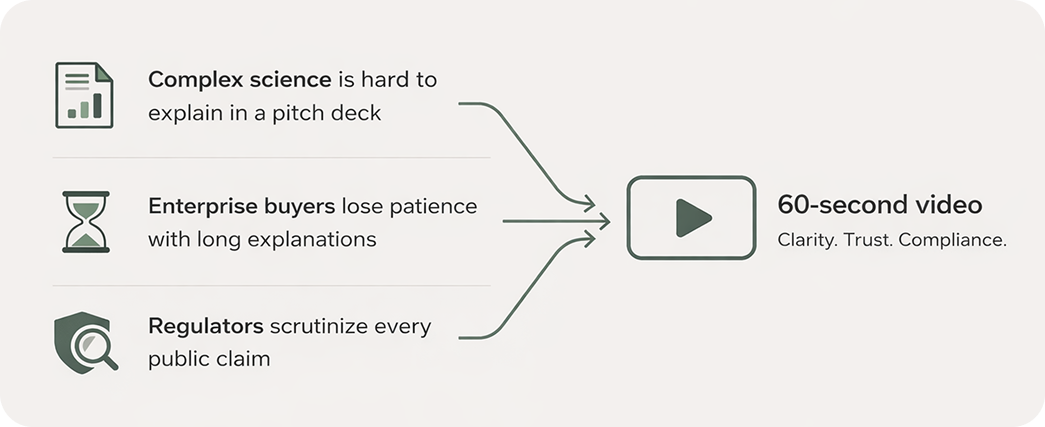
Here is the core problem for climate tech founders. Your science is hard to explain in a pitch deck. Investors skim. Enterprise buyers lose patience. Regulators watch every word.
Video solves all three.
Five Video Formats That Drive Results for Climate Tech Startups
1. The Founder Explainer (Best for Trust)
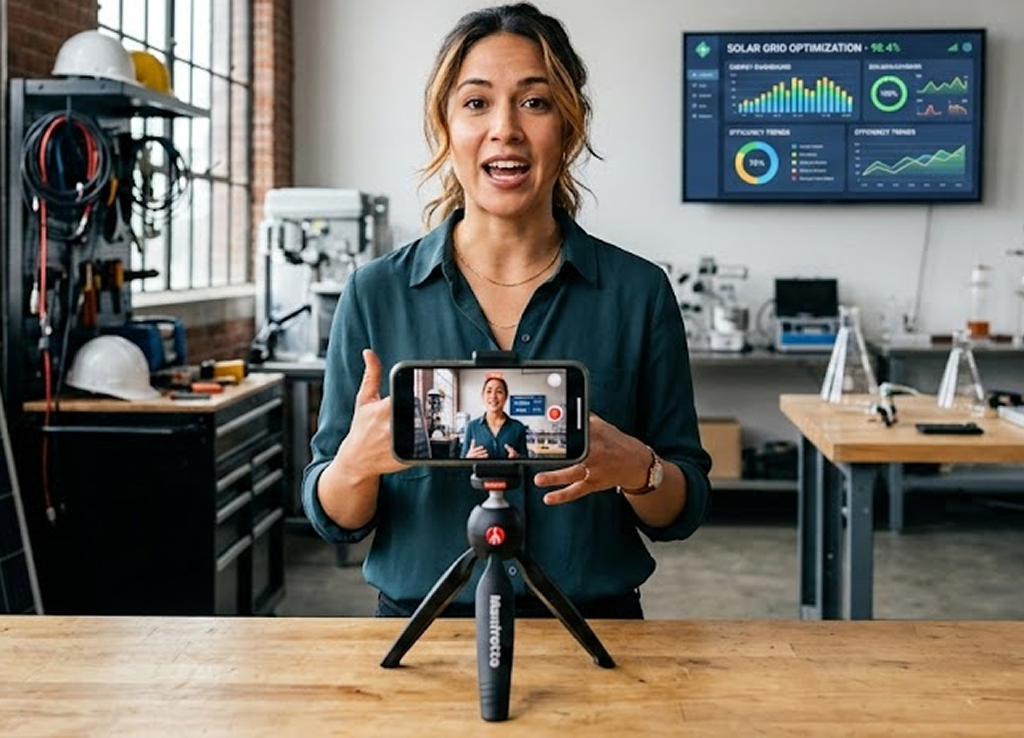
You, on camera, walking through what your technology does and why it matters. No script reading. Just clarity. In our experience working with climate and health tech founders, this is the highest-ROI format for early-stage startups because it builds personal connection with investors.
We break this down in our guide on why founder-led video actually matters.
2. The 60-Second Animated Explainer (Best for Complex Tech)
If your solution involves hydrogen fuel cells or distributed energy systems, animation lets you visualize what a camera cannot. Keep it under 90 seconds. Lead with the problem, not the science.
3. The Social Proof Clip (Best for Enterprise Sales)
A short video testimonial from an early customer or pilot partner. Nothing converts a skeptical procurement team faster than hearing a peer confirm it works.
4. The "Behind the Build" Reel (Best for LinkedIn and TikTok)
Show your lab. Show your pilot site. Show the messy, real process of building climate technology. This format performs well on LinkedIn, which 70% of video marketers now use for B2B distribution, making it the most widely adopted platform for business video.
5. The Data Story (Best for Investors)
Take one compelling metric from your impact data and build a 30-second visual narrative around it. Example: "Our system removed 14,000 tonnes of CO2 in its first year. Here is what that looks like." Investors remember stories, not spreadsheets.

How to Avoid the Greenwashing Trap in Climate Tech Video
The EU's Empowering Consumers for the Green Transition Directive takes effect in September 2026. Generic claims like "eco-friendly," "green," or "carbon neutral" without substantiation will be banned in consumer-facing communications across EU member states.
For video, that means every environmental claim on camera needs to be specific and backed by data. Say "We reduced Scope 2 emissions by 38% across three pilot sites" instead of "We are making the planet greener."
We wrote a full breakdown on how to avoid greenwashing in climate tech marketing.
Where Should Climate Tech Startups Post Video Content?

LinkedIn is where your investors, enterprise buyers, and policy stakeholders spend time. Short native video posts consistently outperform static content.
YouTube Shorts gives you long-term discoverability through search. A well-titled explainer can generate qualified leads for years.
TikTok is where climate tech founders are building public audiences. The platform rewards authenticity and storytelling.
Repurpose every video across all three. One 60-second clip becomes three platform-native posts. For the full strategy, read our guide on short-form video for B2B startups.
Building a Video Strategy Around Your Fundraising Cycle
Climate tech operates in longer capital cycles than most other startup categories. The time between seed and Series A, or between Series A and Series B, can stretch 18 to 36 months. Your video strategy needs to serve multiple audiences simultaneously across that timeline, not just one.
During the seed and early growth phase, video should be doing two things at once: building public awareness of the problem you solve, and demonstrating that you are a founder worth backing. The Founder Explainer and the Data Story formats carry most of the weight here. Investors in this stage are evaluating the person as much as the product.
During the growth and commercial traction phase, your video strategy should shift toward proof. Customer proof videos, pilot results, and measurable impact data become the primary formats. This is the content that enterprise procurement teams and Series B investors need to see before committing. It is also the content that signals commercial maturity to the market.
At every stage, LinkedIn remains the primary distribution channel for investor-facing content. But the growing reality in 2026 is that a significant portion of early climate tech discovery is now happening through AI search. When an investor or enterprise buyer asks ChatGPT or Perplexity about solutions in your space, the content that appears in those responses is content that was written clearly, cited sources, and provided direct factual answers.
This means your YouTube video descriptions, your blog posts accompanying your videos, and your LinkedIn captions should be written with that discoverability in mind. Specific claims, specific numbers, and specific named technologies help AI systems categorize and surface your content in response to relevant queries.
A practical principle for climate tech video at every stage: every video should answer a question a serious buyer or investor would actually ask. Not a question you wish they were asking. The question they are already typing into a search bar or AI tool right now.
What Should Climate Tech Founders Do Next?
You do not need a production crew. You need a phone, a clear message, and a distribution plan.
Film one founder-led video this week. Post it on LinkedIn. Measure the response.
If you want to create a content engine that produces consistent video every month, get in touch with our team. We build video systems for climate tech startups. No greenwashing risk. Just video that drives pipeline.

Frequently Asked Questions