


Video Marketing ROI: How to Measure It and Prove It to Your Team
Most founders know video works. Fewer know how to prove it.
If you have ever had to justify a video budget to a skeptical CFO or co-founder, you know the problem. Views and likes do not pay salaries. You need numbers that connect video directly to business outcomes.
Video marketing ROI measures what your business gets back relative to what it spends on video. Unlike paid ads, video works across the entire funnel: awareness, consideration, and conversion. That is why measuring it requires more than one metric.
Here is the exact framework we use with founders.
What "Video ROI" Actually Means
Video marketing ROI is the total business value generated by video content relative to its production and distribution cost. It is not a single number. It is a set of signals across the funnel that, when tracked together, build an undeniable case.
Video rarely drives a single, traceable transaction the way a paid click does. According to Wyzowl's 2025 State of Video Marketing report, 90% of marketers say video gives them a positive ROI. But only those who track the right metrics can prove it internally.
The mistake most founders make is measuring video like a paid ad. It is not. It compounds.
The 4 Metrics That Actually Matter for Video ROI
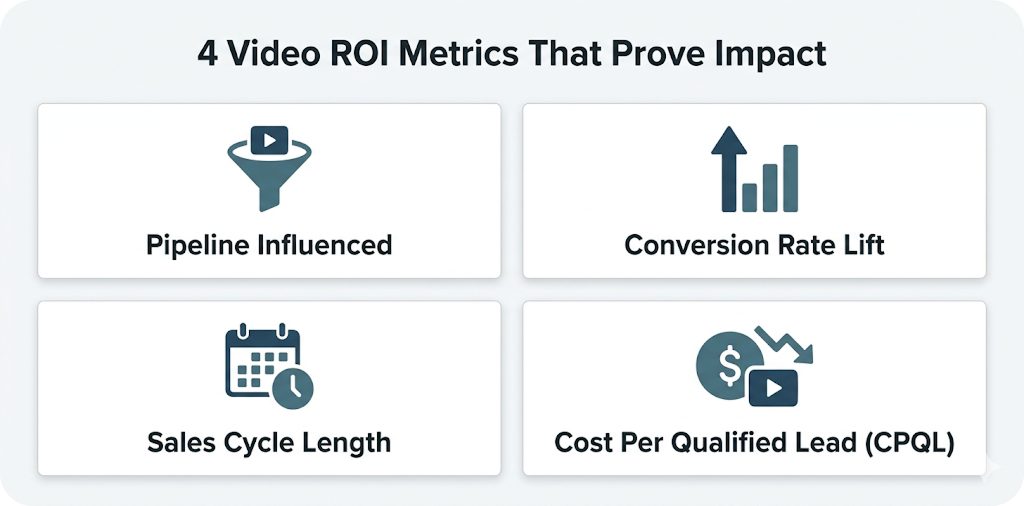
1. Pipeline Influenced
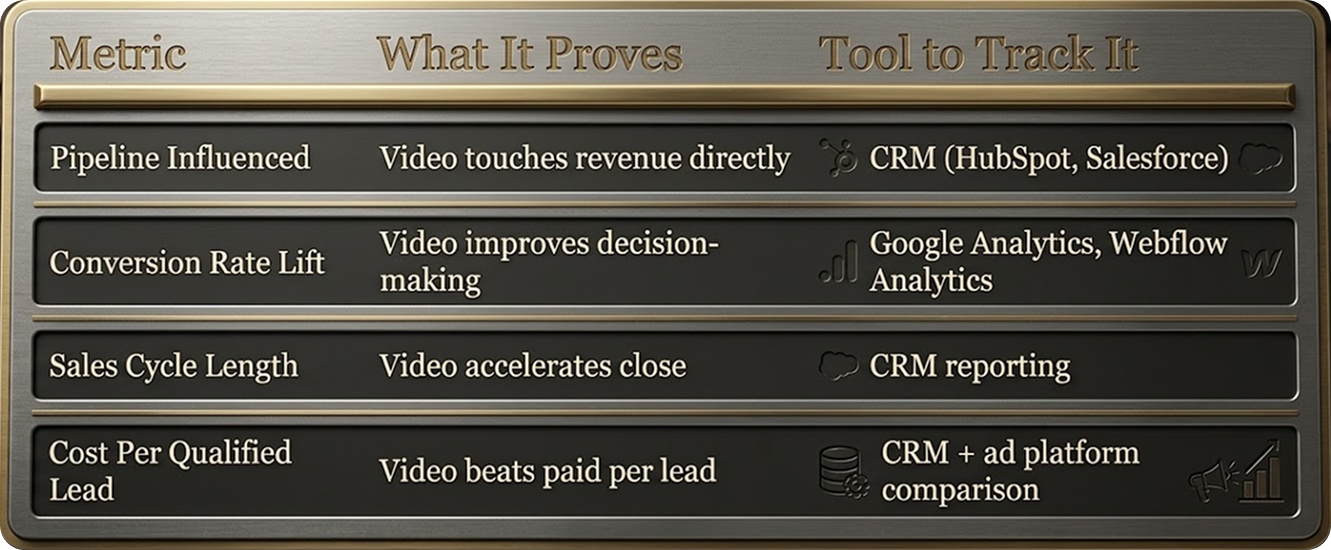
Pipeline influence measures how many closed deals included at least one video touchpoint during the sales process.
Most CRMs (HubSpot, Salesforce, Pipedrive) let you tag content interactions against deal records. If 8 out of 10 deals last quarter touched your founder explainer video before closing, that is a pipeline influence number you can take into any budget conversation.
This is the single most persuasive metric for B2B founders. It connects content directly to revenue.
2. Lead Conversion Rate Lift
Conversion rate lift measures the difference in conversion rates between pages or sequences that include video versus those that do not.
Run the comparison yourself. Add a short video to your pricing page or demo request form, then track the before-and-after conversion rate for 30 days. A 15% lift in demo bookings is concrete. It survives any internal skeptic.
Wyzowl's 2025 data shows that 87% of marketers report video has directly increased sales. Your internal benchmark does not need to match that number. It just needs to be real and documented.
3. Sales Cycle Length
Sales cycle length measures the average number of days from first contact to close, segmented by whether prospects engaged with video content.
Video shortens sales cycles by doing the explaining your team would otherwise do on calls. Shorter cycles mean less time from your salespeople and faster revenue recognition. For early-stage startups, shaving even 10 days off a 45-day average cycle is worth tens of thousands in recovered capacity.
That is an ROI argument any operations or finance lead will understand immediately.
4. Cost Per Qualified Lead (CPQL)
CPQL measures the cost of each qualified lead generated through organic video content, compared against paid channel benchmarks.
Once an organic video content engine is running, most founders find their video-sourced CPQL is a fraction of their paid ad CPQL. The content cost is fixed. The lead volume compounds over time. That ratio is your ROI story.
How to Build Your ROI Report in 4 Steps
You do not need a data team. You need a consistent tracking process from day one.
Step 1: Define one goal per video. Demo bookings, email signups, investor outreach clicks. One goal. One video. No ambiguity.
Step 2: Set a baseline first. What is your current conversion rate or CPQL before the video goes live? Without a baseline, you cannot prove lift.
Step 3: Tag everything. Use UTM parameters on every video link. Connect YouTube and LinkedIn analytics to your CRM or Google Analytics. This takes 20 minutes to set up and pays off immediately.
Step 4: Report at 30, 60, and 90 days. Video compounds. The 30-day number will often disappoint. The 90-day number is usually the one worth showing to stakeholders.
The Part Most ROI Guides Skip
Not all video ROI lives in a spreadsheet. Brand trust, investor confidence, and inbound hiring interest are real returns. They are just harder to quantify.
A climate tech founder we work with used a single 90-second founder story video in investor outreach. It had no UTM link. But three investors mentioned it specifically on their first calls. Two of them said it was why they took the meeting.
That is ROI. Document those signals as qualitative evidence. Combine them with your hard numbers for a complete picture that covers every type of stakeholder in the room.
How to Frame It for Skeptical Stakeholders

When presenting video ROI internally, lead with the business outcome, not the video metric.
Do not say: "Our Reels got 40,000 views."
Say: "Video contributed to 6 demo bookings this month at one-third the cost of our paid campaigns."
That reframe is the difference between video being seen as a marketing expense and video being seen as a growth lever. The data is often identical. The framing determines whether it survives the budget conversation.
The Compounding Argument That Wins Every Budget Conversation
There is one argument for video ROI that most measurement guides miss entirely: the compounding cost curve.
When you run a paid ad campaign, the moment you stop paying, the reach stops. Every lead costs approximately the same amount regardless of how long you have been running the campaign. The economics are linear.
Video content works on an opposite curve. The production cost is fixed. A founder explainer filmed in month one costs the same to produce whether it is watched by 200 people or 20,000. As the video accumulates organic reach over time, the cost per viewer drops toward zero. A well-optimized YouTube video or LinkedIn clip from six months ago is still generating inbound today at no incremental spend.
This compounding structure is the most compelling financial argument for video in any budget conversation. Frame it this way: every piece of video content you create is a permanent asset on your marketing balance sheet. Paid ads are an operating expense that disappears when you stop paying. Video is a capital investment that keeps producing returns.
That reframe shifts the conversation from "is this expensive?" to "how quickly does it compound?" And that is a conversation most finance and operations stakeholders are far more comfortable having.
Ready to Build a Video Strategy Designed Around Measurable ROI?
At Alluvium Media, we work with health tech, wellness, and climate tech founders to create short-form video strategies built around measurable outcomes, not vanity metrics.
We define your KPIs before a single frame is filmed, so you always have something concrete to report.
See how we work with founders or get in touch directly.
Want the full strategic picture first? Read our B2B Video Marketing Strategy for 2026.

Frequently Asked Questions



.png)